Authem: Bold, Vintage Charm in Every Letter
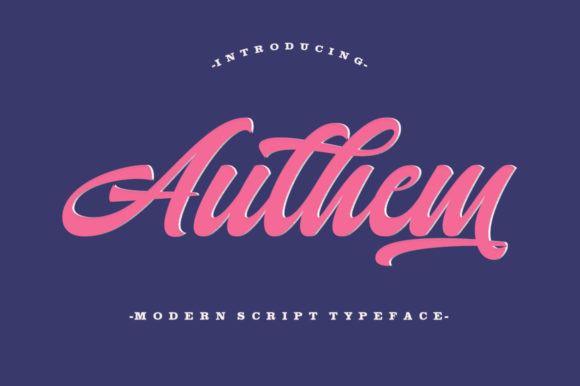
There’s a quiet magic in fonts that don’t just say something—but feel like something. Authem is one of those rare typefaces: a script font that balances playful energy with confident structure. It’s not merely decorative; it’s expressive, intentional, and surprisingly versatile. Whether you're hand-lettering a wedding invite, designing a café chalkboard menu, or branding a small-batch candle line, Authem brings an unmistakable vintage warmth—without tipping into cliché.
What Makes Authem Stand Out?
At first glance, Authem reads as effortlessly handwritten—yet every curve, stroke, and connection is carefully crafted for consistency and impact. Its bold weight gives it presence on both digital screens and printed materials, while its subtle irregularities (a slightly uneven baseline, a tapered terminal here, a generous loop there) echo the charm of mid-century signage and artisanal packaging.
Unlike many script fonts that sacrifice legibility for flair, Authem maintains strong character distinction—even at smaller sizes. The uppercase “S”, “G”, and “Q” have distinctive shapes that avoid confusion. Lowercase letters flow naturally, with generous spacing built into the design to prevent crowding. That balance between personality and practicality is what makes Authem more than just a trend—it’s a tool.
Key Characteristics, Explained Simply
- Bold by design: Authem isn’t thin or delicate. Its confident weight ensures visibility on signage, social media thumbnails, and product labels—even without extra effects or outlines.
- Vintage, not dated: Inspired by 1940s–60s American lettering, Authem avoids overused tropes (like excessive swashes or distressed textures). Instead, it leans into clean rhythm and warm proportions.
- Script with structure: Letters connect smoothly, but not automatically—giving designers full control over word spacing and emphasis. You can use connected or spaced variants depending on context.
- Web- and print-ready: Authem includes OpenType features like ligatures, alternate characters, and stylistic sets—so you’re not stuck with default pairings when “To” or “The” needs extra elegance.
Who Benefits Most From Using Authem?
Authem speaks fluently to several creative audiences—not because it tries to please everyone, but because it solves specific, real-world problems.
Crafters & DIY Enthusiasts
If you’ve ever spent hours tracing lettering for a mason jar label or struggled to make hand-painted signs feel cohesive, Authem simplifies the process. Use it in cutting machines (Cricut, Silhouette) for vinyl decals, iron-on transfers, or wood-burned quotes. Its bold lines translate cleanly at any scale—and its vintage tone pairs beautifully with linen, kraft paper, and matte ceramic finishes.
Small Business Owners & Local Brands
Think: neighborhood bakeries, indie bookshops, handmade soap studios, or boutique fitness studios. These businesses thrive on authenticity and approachability—qualities Authem reinforces visually. A logo using Authem feels human-scaled, trustworthy, and memorable. Pair it with a clean sans-serif (like Montserrat or Poppins) for body text, and you’ve got a balanced, ownable identity system—no designer required.
Graphic Designers & Marketing Teams
Authem works especially well where emotion drives engagement: event posters, email headers, Instagram story highlights, or limited-edition packaging. It’s not meant for long paragraphs—but it excels at short, high-impact moments. One designer recently used Authem for a concert series poster series; attendees told her the typography alone made them “feel the vibe before reading a word.” That’s the power of intentional type.
Where Authem Shines—And Where to Pause
Like any strong voice, Authem thrives in the right setting—and fades in the wrong one. Here’s how to gauge fit:
Best Uses
- Headlines and titles — blog banners, podcast cover art, YouTube thumbnails
- Product naming — flavor names on jam jars, scent titles on candle labels, collection names on apparel tags
- Invitations & announcements — weddings, baby showers, gallery openings, pop-up markets
- Social media visuals — quote graphics, sale banners, “new arrival” posts
- Handmade packaging — stamped tape, custom stickers, ribbon seals
Limited or Challenging Uses
- Long-form body text: Authem isn’t built for readability beyond a few words. Reserve it for emphasis—not explanation.
- Ultra-minimalist or tech-forward brands: If your aesthetic leans into sleek monochrome, sharp geometry, or futuristic UI, Authem may clash rather than complement.
- Low-resolution displays: While optimized for modern screens, very small sizes (<14px) on older devices may lose some nuance—test before finalizing web use.
- Strict accessibility contexts: As a decorative script, Authem shouldn’t replace accessible heading fonts (e.g., in HTML
elements). Use it for visual flair, not semantic structure.
Real Projects, Real Results
A Portland-based florist switched from a generic brush font to Authem for her seasonal bouquet cards. Within two months, customer photos tagging her shop increased by 37%—and multiple people commented, “Your handwriting is *so* you.” She wasn’t handwriting them. She was using Authem thoughtfully: large, centered, with plenty of breathing room and a soft watercolor background.
Another example: a teacher creating printable classroom resources. She used Authem for “Reading Corner” and “Math Masters” headers—then paired it with a friendly, highly legible sans-serif for instructions. Students responded more enthusiastically to materials that felt inviting and intentional—not sterile or overly academic.
Even non-designers find success. A home cook launched a weekly newsletter called The Sunday Simmer. She used Authem only for the title banner image—nothing else. Subscribers began screenshotting and sharing it. “It looks like something my grandma would write on a recipe card,” one wrote. That emotional resonance? That’s Authem working as intended.
Evaluating Authem for Your Next Project
Ask yourself three simple questions before committing:
- Is this about feeling—or function? If the goal is warmth, nostalgia, craftsmanship, or personal connection, Authem is likely a strong match. If clarity, speed, or neutrality is top priority, consider alternatives.
- How much space does the text occupy? Authem earns its keep in headlines, logos, and short phrases. If you need to set a paragraph—or even a sentence longer than eight words—step back and choose a supporting font instead.
- Does it align with your audience’s expectations? A luxury skincare brand targeting Gen Z might use Authem sparingly (on a limited drop label), while a heritage bakery could build its entire visual language around it. Context shapes impact.
Finally, test early and often. Type out your actual phrase—not placeholder text—in Authem. Resize it. Print it. View it on a phone. Does it still feel right? Does it support your message—or distract from it? Authenticity starts with honesty in execution.
Wrapping Up: More Than Just a Font
Authem doesn’t shout. It leans in. It invites. It adds texture to flat surfaces and soul to digital spaces. It’s proof that thoughtful typography isn’t about complexity—it’s about choosing the right voice for the moment.
You don’t need a design degree to use Authem well. You just need to know what you’re trying to say—and who you’re saying it to. When those align, Authem becomes more than a cool script font. It becomes part of the story.
Ready to try it? Many platforms offer Authem through subscription services or one-time licenses—including Google Fonts (where available), Font Squirrel, and major design tools like Adobe Creative Cloud. Always verify licensing terms for commercial use—especially for merchandise or client work.