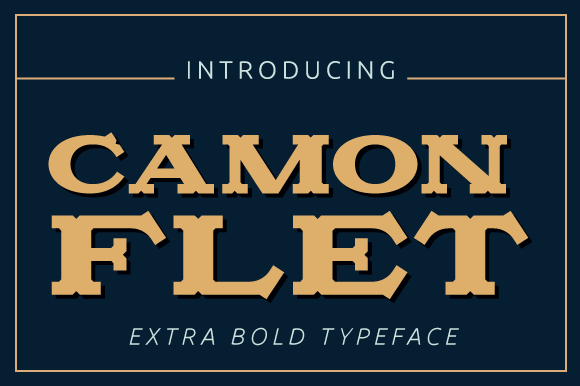
Camonflet: A Bold Vintage Serif for Impactful Design
Camonflet isn’t just another serif font—it’s a confident, high-contrast typographic statement rooted in early 20th-century craftsmanship. With its strong serifs, generous x-height, and subtle calligraphic warmth, Camonflet balances authority and approachability in a way few vintage-inspired fonts do. It doesn’t shout for attention; it commands it—quietly, deliberately, and with unmistakable presence.
What sets Camonflet apart is how it bridges eras: its structure feels archival, even timeless, yet its spacing, weight distribution, and character set are optimized for modern readability—on screen and in print. That duality makes it unusually versatile. You’ll find designers reaching for Camonflet not only for period-accurate branding but also for contemporary projects where clarity, gravitas, and quiet distinction matter.
Where Camonflet Shines Most
Camonflet excels in contexts where typography carries meaning—not just information. Think of it as your go-to when the typeface needs to reflect intention, care, or legacy. It works especially well in:
- Editorial design: Magazine mastheads, chapter openers, pull quotes, and feature headlines benefit from Camonflet’s rhythmic contrast and strong vertical stress.
- Branding for craft-based businesses: Artisan bakeries, independent bookshops, letterpress studios, and heritage apparel brands use Camonflet to signal authenticity without leaning into cliché.
- Educational and cultural institutions: University course catalogs, museum exhibition titles, and nonprofit annual reports gain visual weight and trustworthiness with thoughtful Camonflet usage.
- Printed collateral: Business cards, letterhead, posters, and packaging—especially when paired with minimalist layouts—let Camonflet anchor the composition with elegance and restraint.
Practical Pairings and Layout Tips
Camonflet performs best when given room to breathe. Avoid tight tracking or cramped line heights—its strength lies in its structure, not density. For body text, stick to its lighter weights (Regular or Light) at 16–18px with generous leading (1.5–1.7x). Reserve Bold and Black weights for headings, logos, or short impactful phrases.
Pairing Camonflet thoughtfully expands its range. Its vintage soul harmonizes with clean, neutral sans-serifs like Inter, Poppins, or Source Sans Pro—creating a balanced contrast between tradition and utility. For a more cohesive retro feel, try it alongside geometric sans-serifs like Montserrat or modest slab-serifs like Courier Prime—but always test readability at real sizes and distances.
When setting Camonflet in all caps, reduce tracking slightly to maintain rhythm. In lowercase settings, watch for potential crowding in words with tall ascenders (like “b,” “d,” “h”) next to deep descenders (“g,” “p,” “q”). A small optical adjustment—just 1–2 units—often improves flow without compromising integrity.
Real Projects, Real Decisions
A Portland-based ceramics studio used Camonflet Bold for their logo and product labels, then paired it with a warm, low-contrast sans-serif for website copy. The result? Instant recognition on shelves and online—customers reported feeling the brand was “thoughtful, skilled, and grounded.” No extra explanation needed.
An independent history podcast chose Camonflet Light for episode titles in their show notes and social graphics. Its readability at small sizes (even on mobile thumbnails), combined with its scholarly resonance, helped reinforce credibility without sounding academic or distant.
A freelance educator designing workshop handouts opted for Camonflet Italic for section headers and key takeaways. The subtle slant added emphasis without distraction—and because Camonflet’s italic retains the same robust stroke contrast as its roman, the hierarchy felt intentional, not decorative.
Adapting Camonflet Across Audiences and Platforms
For marketers and small business owners: Use Camonflet to elevate email subject lines or landing page headlines—but only where tone aligns. It won’t suit a playful fintech app, but it *will* strengthen a values-driven wellness brand or a boutique consultancy. Ask yourself: Does this project benefit from perceived experience, care, or continuity? If yes, Camonflet fits.
For educators and content creators: Camonflet adds visual authority to slide decks, syllabi, and downloadable resources—especially when consistency matters across multiple documents. Export slides as PDFs with embedded fonts, and use variable font files (if available) to keep file sizes lean.
For bloggers and publishers: Consider Camonflet for article titles and bylines—not body text. Its personality shines brightest in moments of emphasis. If your CMS supports custom CSS, apply it selectively via class names rather than globally. This preserves flexibility and avoids overcommitting to one voice across every post.
For developers and designers working in responsive environments: Test Camonflet across viewports. Its heavier weights can appear dense on small screens—so define clear breakpoints. For example, switch from Camonflet Bold to Regular at tablet width, and consider a fallback stack that maintains contrast and hierarchy if the font fails to load.
Maintaining Clarity and Consistency
Using Camonflet well means resisting the urge to overuse it. Its power comes from contrast—not repetition. Limit it to two weights maximum in any single project. Define clear rules: “Camonflet Bold = primary headline only,” “Camonflet Regular = subheads and captions,” and stick to them. Document those choices in a simple style guide—even a shared note or checklist helps maintain coherence across collaborators.
Also remember: Camonflet isn’t about nostalgia for its own sake. It’s about choosing a voice that matches your message’s substance. A coffee roaster using Camonflet isn’t saying “we’re old”—they’re saying “we pay attention to detail, source intentionally, and value craft.” Let the font support that story—not tell it alone.
If you're evaluating Camonflet for your next project, start small. Try it on one asset—a logo lockup, a social graphic, a cover page. See how it changes the perception of your content before scaling up. Notice how readers pause, how clients respond, how teammates interpret tone. That feedback is more valuable than any trend report.
Ultimately, Camonflet rewards thoughtful application—not decoration. It’s a tool for people who believe typography should serve purpose first, aesthetics second, and ego never. When used with intention, it doesn’t just look good. It communicates clearly, builds trust, and stays memorable—long after the first glance.