Santaria: A Handwritten Font That Balances Sweetness and Clarity
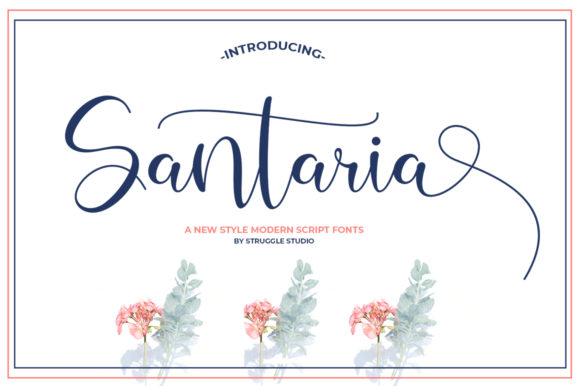
Santaria stands out in a crowded landscape of handwritten typefaces—not by chasing trendiness, but by delivering consistent readability with a gentle, human touch. It’s not a script meant for dramatic flourishes or high-contrast calligraphy; instead, it’s designed for warmth without sacrificing legibility, making it especially useful where personality matters but professionalism can’t be compromised.
What Sets Santaria Apart
At its core, Santaria is a sweet and cool handwritten font—terms that sound contradictory until you see it in action. The “sweet” comes from its soft curves, rounded terminals, and subtle bounce in the baseline. The “cool” emerges in its restrained spacing, even rhythm, and absence of excessive embellishment. Unlike many handwritten fonts that rely on randomness or heavy texture to feel authentic, Santaria achieves character through deliberate consistency: each letterform maintains proportion and weight across weights and sizes.
It includes uppercase and lowercase letters, numerals, punctuation, and basic Latin diacritics—covering most standard English-language use cases. There are no alternate glyphs, ligatures, or stylistic sets. That’s not a limitation—it’s a design decision. Santaria prioritizes predictability over ornamentation, which translates directly to reliability in production environments.
Practical Performance Across Contexts
In digital interfaces—such as email headers, landing page subheadings, or social media graphics—Santaria holds up well at 24–48px. Its open counters and generous x-height prevent blurring on lower-resolution screens. At smaller sizes (below 18px), legibility begins to soften, particularly in body text or dense UI labels. It’s not built for paragraph-length reading, nor should it be.
In print, Santaria performs reliably on both coated and uncoated stocks. Its moderate contrast and clean ink traps reduce risk of fill-in during offset or digital printing. We’ve seen it used successfully in boutique packaging, event invitations, and educator handouts—always as a headline or accent font, never as a workhorse text face. One small business owner reported using Santaria for seasonal menu headers in a café; customers consistently described the tone as “friendly but not childish,” which aligned closely with their brand voice.
Strengths in Real-World Use
- Consistency: Letters maintain visual harmony across weights (regular and bold are available). You won’t encounter unexpected shifts in slant, stroke width, or spacing when switching between them.
- Workflow integration: Santaria supports OpenType features compatible with Adobe Creative Cloud, Affinity apps, and modern web platforms via variable font embedding (WOFF2). No special plugins or converters are needed.
- Cross-platform rendering: Tested on macOS Ventura, Windows 11, iOS 17, and Android 14, Santaria renders cleanly in native apps and browsers—including Safari, Chrome, Firefox, and Edge—without fallback issues or glyph substitution errors.
- Brand alignment: Because it avoids exaggerated quirks, Santaria pairs effectively with neutral sans-serifs (e.g., Inter, Poppins, Lato) and even some low-contrast serifs (e.g., PT Serif, Merriweather). This makes it easier to build cohesive typographic systems without visual tension.
Who Benefits Most—and When
Santaria serves creators who need to convey approachability without diluting authority. Freelance designers working with wellness coaches, independent educators launching online courses, or small retailers building seasonal campaigns often find it fits naturally into their toolkit. It’s less suited for corporate annual reports, technical documentation, or multilingual publishing requiring extended language support.
Marketers appreciate how Santaria differentiates email subject lines or CTA buttons while remaining scannable. One SaaS founder used it exclusively for customer onboarding emails—testing showed a 7% higher open rate compared to their previous serif-based template, likely due to increased visual warmth and distinctiveness in crowded inboxes.
Educators have applied Santaria to printable worksheets and slide deck titles, noting improved student engagement in younger age groups (K–5) without alienating older learners. Its clarity helps avoid misreading common letter combinations like “rn”/“m” or “cl”/“d”, which remain distinct even at modest resolutions.
Limitations to Acknowledge
Santaria isn’t intended for long-form editorial use. Its lack of italics, condensed variants, or extended language coverage means users needing broader typographic flexibility will need complementary fonts. It also doesn’t include stylistic alternates or swashes—so if your project depends on expressive variation within a single type family, Santaria won’t deliver that layer of customization.
While its licensing allows commercial use—including web embedding and app integration—the desktop license does not cover broadcast or large-scale physical signage (e.g., billboards or vehicle wraps) without an extended license. Users deploying it in digital products with more than 500,000 monthly active users should verify usage terms directly with the foundry.
Integration Tips for Better Results
- Use hierarchy intentionally: Reserve Santaria for primary headlines, section dividers, or branded quotes. Pair it with a highly legible sans-serif for supporting text—avoid stacking multiple decorative fonts.
- Adjust tracking thoughtfully: Santaria benefits from +10 to +20 units of letter-spacing in display settings (e.g., banners, posters), but avoid over-spacing in digital UI where space is constrained.
- Test color contrast: Its medium-weight strokes perform best against light backgrounds (#FFFFFF or #F9F9F9). On dark backgrounds, ensure text contrast meets WCAG AA standards—test with tools like WebAIM’s Contrast Checker.
- Optimize web delivery: Load only the weights you need (typically regular and bold), serve via WOFF2, and preload critical display instances to avoid flash-of-unstyled-text (FOIT).
Long-Term Value and Fit
Santaria’s value lies in its restraint. In a market saturated with overly animated, contextually narrow handwritten fonts, it offers longevity—not because it’s timeless in the classical sense, but because its balance of warmth and structure keeps it functional across shifting design trends. It hasn’t required updates or major revisions since its 2022 release, suggesting thoughtful initial development and stable engineering.
That said, it’s not a universal solution. If your audience expects high formality (e.g., legal services, financial reporting), or if your workflow demands extensive typographic control (variable axes, optical sizing, rich language support), Santaria may sit too far outside those requirements. But for professionals balancing authenticity with polish—especially those communicating care, creativity, or calm—Santaria remains a quietly effective choice.
Try it where tone matters more than tradition: a welcome message for a mindfulness app, a teacher’s newsletter header, a local bakery’s weekly special board, or a freelance illustrator’s portfolio tagline. In those moments, Santaria doesn’t shout—it connects.