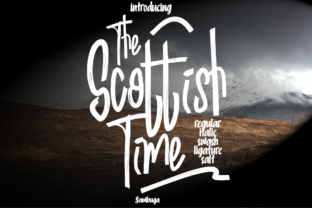
Scottish Time
Scottish Time is a light brush font with an adventurous, outdoorsy character—fluid yet grounded, expressive but never chaotic. It’s not merely decorative; it carries tone, intention, and context in its strokes. For professionals who understand that typography is a strategic tool—not just a visual choice—Scottish Time offers a rare blend of approachability and distinction. It doesn’t shout. It invites. And when used with purpose, it helps designs resonate more deeply with audiences who value authenticity, movement, and human craft.
Why Scottish Time Fits Real-World Strategy
Typography shapes perception before a single word is read. Scottish Time signals something specific: energy without urgency, creativity without clutter, confidence without rigidity. That makes it especially useful for brands and creators operating at the intersection of nature, exploration, education, or personal growth—think outdoor gear startups, independent publishers, wellness educators, or artisanal service providers. Its brush texture implies hand-drawn care; its light weight avoids heaviness or formality. This isn’t a font for legal disclaimers or enterprise dashboards. It’s for moments where warmth, motion, and intention matter more than uniformity.
Strategically, Scottish Time supports differentiation in saturated markets. When competitors rely on overused sans-serifs or generic script fonts, Scottish Time introduces subtle contrast—enough to stand out, not so much that it alienates. It works because it feels intentional, not arbitrary. That intentionality is what builds trust: readers sense that someone chose this font because it aligns with what they’re trying to say—not because it was the first option in a dropdown menu.
Where Scottish Time Adds Value—Not Just Visual Flair
Consider these practical applications:
- Brand identity systems: Used selectively—as a logo lockup, headline treatment, or chapter title—it reinforces a brand’s personality without compromising legibility or scalability. A hiking apparel brand might use Scottish Time for trail journal covers or workshop banners, pairing it with a clean, functional sans-serif for body text.
- Educational materials: In online courses or printed workbooks focused on creativity, resilience, or place-based learning, Scottish Time adds tactile warmth. It softens dense information without undermining authority—especially effective when paired with thoughtful spacing and restrained color palettes.
- Event and experience design: Festivals, retreats, or community workshops benefit from fonts that suggest participation rather than passive consumption. Scottish Time’s rhythm echoes handwriting, sketching, and spontaneity—qualities that support engagement over polish.
- Digital storytelling: On blogs or newsletters where voice matters as much as content, Scottish Time (used sparingly in headings or pull quotes) can deepen emotional resonance. It subtly cues the reader: “This isn’t automated. This is human.”
Using Scottish Time Intentionally—Not Instinctively
Intention begins with alignment. Ask: Does Scottish Time reflect the outcome you want—not just the look you like? If your goal is clarity in a technical guide, Scottish Time may slow comprehension. If your aim is memorability in a festival poster, it may elevate recall. The difference lies in matching typographic character to communicative function—not aesthetic preference.
Start by auditing your current touchpoints. Where do users pause? Where do they skim? Where do they decide whether to stay or leave? Scottish Time earns its place where attention is earned through feeling—not speed. Use it where you want people to lean in, not scroll past.
Also consider hierarchy. Because Scottish Time is light and textured, it performs best at larger sizes and with generous line-height. Pair it with typefaces that provide structural balance—a sturdy grotesque for captions, a warm serif for long-form reading. Avoid stacking multiple decorative fonts. Scottish Time gains strength from contrast, not competition.
Risks of Misalignment
Without clear goals, Scottish Time can unintentionally signal informality where authority is needed—or whimsy where precision matters. A financial advisor using it in client onboarding documents may inadvertently undercut credibility. A university department applying it across all signage might dilute institutional gravitas. These aren’t flaws in the font—they’re mismatches between typographic character and situational demand.
Another risk is overuse. Because it’s distinctive, there’s temptation to apply Scottish Time everywhere—to headlines, subheads, buttons, and even data labels. But distinctiveness loses power when it becomes noise. Its impact depends on restraint. Think of it like a signature ingredient: essential in the right dish, overwhelming if added to every course.
Planning Tips for Practical Adoption
Before integrating Scottish Time into your workflow, run these checks:
- Define the primary outcome: Are you aiming to increase sign-ups, deepen engagement, strengthen brand recognition, or improve comprehension? Scottish Time serves outcomes—not aesthetics.
- Map usage to user journey stages: It often works best at entry points (hero sections, email subject lines, cover images) and emotional pivot points (testimonials, mission statements, call-to-action headers)—not in dense procedural text.
- Test readability across devices: Its brush texture can soften on small screens or low-resolution displays. Always preview at 100% zoom on mobile, tablet, and desktop before finalizing.
- Assess licensing and technical fit: Confirm it’s licensed for your intended use—web, app, print, or merchandise—and that it renders consistently across browsers and platforms. Some brush fonts lack robust hinting or OpenType features needed for professional deployment.
- Document rationale: Note why you chose Scottish Time for each application—not just “it looked nice,” but how it supports a specific goal. This builds internal alignment and makes future iterations more deliberate.
Long-Term Positioning and Evolution
Brands evolve. Audiences shift. Markets mature. A font chosen for early-stage differentiation may need reevaluation as scale increases. Scottish Time holds up well over time precisely because it avoids trend-driven gimmicks—it leans into craft, not novelty. That gives it longevity, provided its use remains anchored in strategy.
Over months or years, revisit how Scottish Time functions within your broader visual language. Does it still reflect who you serve—and who you’re becoming? Has its meaning shifted in cultural context? For example, a brand that launched with Scottish Time to signal “handmade authenticity” may later layer in bolder supporting type to express growing capability—without abandoning the original voice.
This kind of evolution isn’t about chasing trends. It’s about stewardship: treating typography as part of your operational infrastructure, not just a one-time design decision. Scottish Time supports that mindset because it’s flexible enough to adapt—but distinctive enough to retain identity.
A Final Strategic Observation
Typography choices rarely fail because of the font itself. They fail because they’re disconnected from purpose, audience, or environment. Scottish Time succeeds when it’s selected as part of a coherent system—not as a stylistic flourish. It thrives when paired with strong writing, smart layout, and consistent tone. Used that way, it does more than look good. It helps people feel seen, understood, and invited in.
If you’re evaluating Scottish Time for your next project, don’t ask, “Does this look cool?” Ask instead: “Does this help the right people understand the right thing, at the right time—and feel motivated to act?” That question shifts focus from decoration to decision-making. And that’s where real design advantage begins.