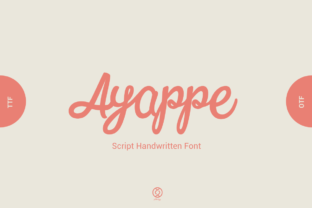
Ayappe: A Handwritten Japanese Script Font
Ayappe is a thoughtfully crafted handwritten font that draws gentle inspiration from traditional Japanese hiragana—those soft, flowing characters you see in everyday Japanese writing. It’s not a direct replica or a calligraphy simulation, but rather a modern reinterpretation: warm, approachable, and unmistakably human. If you’ve ever admired the quiet elegance of ink-on-paper hiragana—its subtle curves, rhythmic spacing, and organic rhythm—you’ll feel that same calm intention in Ayappe.
What Makes Ayappe Stand Out
Unlike many decorative script fonts, Ayappe avoids exaggerated flourishes or forced personality. Its letters connect naturally, with gentle entry and exit strokes that echo how a pen moves across paper—not how a vector tool traces it. The lowercase forms carry quiet confidence; capitals are understated, never dominant. There’s no sharp contrast between thick and thin strokes—just consistent warmth and light variation, like ink pressed gently by hand.
This restraint is intentional. Ayappe works because it feels familiar without being generic. It bridges cultural nuance and universal readability—ideal for creators who want authenticity without alienating non-Japanese audiences. You don’t need to know hiragana to appreciate its flow, but if you do, you’ll spot thoughtful nods: the soft loop of “re”, the downward curve of “yu”, the balanced asymmetry reminiscent of brushwork.
Who Benefits Most From Using Ayappe
Designers building mood boards for wellness brands often reach for Ayappe when they want softness without cliché. Educators crafting printable Japanese language worksheets use it to model friendly, legible handwriting—especially for beginners learning stroke order and rhythm. Bloggers writing about mindfulness, tea culture, or slow living find it pairs beautifully with serif body text, adding texture without distraction.
Small business owners running handmade goods shops—think ceramic studios, indigo-dyed textiles, or matcha cafes—use Ayappe for packaging labels, thank-you cards, and Instagram story highlights. Its warmth reinforces values like care, craft, and continuity. Freelancers designing digital newsletters for creative clients sometimes apply Ayappe sparingly: just for section headers or pull quotes—enough to signal intention, not overwhelm.
Real-World Uses That Just Work
Here’s where Ayappe shines without overreaching:
- Printed stationery: Wedding invitations, poetry chapbooks, or artisanal product tags—where tactile quality matters.
- Digital interfaces: Subtle use in app onboarding screens or portfolio site headings (paired with a clean sans-serif for body copy).
- Educational materials: Flashcards for hiragana learners, bilingual children’s books, or classroom posters emphasizing rhythm and form.
- Social media visuals: Quote graphics for Instagram or Pinterest—especially when the message leans poetic, reflective, or personal.
One freelance illustrator recently used Ayappe for a limited-run zine about seasonal rituals in Kyoto. She didn’t try to make every page “Japanese”—instead, she applied the font only to haiku titles and chapter breaks. The result felt grounded, intentional, and quietly evocative—not costumed.
Things to Keep in Mind Before You Use Ayappe
Ayappe is designed for expression—not utility. That means it’s best suited for short bursts of text: headlines, quotes, labels, names. Avoid using it for long paragraphs, data tables, or interface buttons requiring high legibility at small sizes. At under 12pt on screen or below 8pt in print, details soften and spacing can blur.
Also consider context carefully. While Ayappe honors hiragana aesthetics, it’s not a replacement for proper Japanese typography in bilingual or formal contexts. For official documents, signage, or native-language content, always consult with a Japanese-speaking designer or linguist. Ayappe’s strength lies in its interpretive voice—not linguistic accuracy.
Another practical note: Ayappe includes standard Latin characters and basic punctuation, but no extended multilingual support (e.g., Vietnamese diacritics or Cyrillic). If your project requires broad language coverage, pair it with a robust companion font—and test thoroughly across devices and platforms.
Getting Started Is Simple
You don’t need design experience to begin. Try this low-stakes experiment: open a blank document, type a single line—“breathe”, “slow down”, or “made with care”—and set it in Ayappe at 24–36pt. Adjust letter spacing slightly (+10–20 units) to let the shapes breathe. Now place it beside your usual sans-serif headline. Notice how the tone shifts—not louder, but deeper.
For educators, try printing a simple hiragana chart using Ayappe alongside a standard textbook font. Ask students which version feels more inviting to trace. You’ll likely hear comments about “flow”, “ease”, or “less pressure”—which says something meaningful about how type influences learning presence.
Why This Kind of Thoughtfulness Matters
In a world saturated with hyper-polished, algorithm-optimized fonts, Ayappe offers something quieter: space for breath, room for imperfection, and respect for tradition without imitation. It doesn’t shout—it invites closer looking. That makes it especially valuable for people building brands rooted in authenticity: therapists designing client handouts, writers launching a newsletter about attention and craft, or makers documenting their process online.
And because it’s built with real-world use in mind—not just visual appeal—it scales gracefully across formats. Whether viewed on a phone screen during morning coffee or held in hand as a printed recipe card, Ayappe retains its quiet integrity. No gimmicks. No forced trends. Just steady, human-centered design.
If you’re drawn to typography that feels both personal and purposeful, Ayappe is worth exploring—not as a trend, but as a tool for gentle emphasis, cultural resonance, and mindful communication.