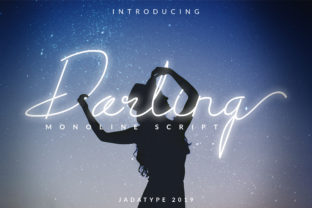
Darling Font
Darling is a handwritten typeface designed to evoke warmth, authenticity, and approachability. It features smooth, confident strokes with subtle irregularities that mimic natural pen-on-paper movement—yet maintains enough consistency to remain legible and versatile. Its bold weight gives it presence without sacrificing charm, making Darling particularly effective in contexts where personality and clarity must coexist.
Unlike many decorative scripts that prioritize flair over function, Darling balances expressiveness with practicality. It’s not merely ornamental; it’s engineered for real-world application—whether on packaging, digital interfaces, editorial layouts, or branding assets. That balance is what draws designers who need more than just “cute” or “trendy”: they need intentionality rooted in typographic craft.
Why Designers Consider Darling
Designers often seek fonts that communicate tone as clearly as they convey text. Darling appeals when the goal is to signal sincerity, craftsmanship, or human-centered values—without leaning into clichéd “handmade” tropes. Its bold flavor ensures visibility at medium sizes, while its organic rhythm helps soften otherwise rigid layouts.
It’s especially relevant for projects centered around lifestyle, wellness, food, education, or small-batch goods—sectors where audience trust hinges on perceived authenticity. A café menu, a boutique skincare label, or an independent newsletter may all benefit from Darling’s quiet confidence: it feels personal but not private, friendly but not informal.
Key Benefits of Using Darling
- Legibility at scale: While clearly handwritten, Darling avoids excessive flourishes that hinder readability. Its x-height is generous, and letterforms are spaced to support scanning—even in short headlines or call-to-action buttons.
- Distinctive yet restrained: It stands out among common sans-serif and script fonts without demanding attention for its own sake. This makes it suitable for brands seeking differentiation without visual noise.
- Cross-medium adaptability: Darling performs well in both print and digital environments. Its bold weight holds up on screens, and its texture translates effectively to physical materials like letterpress or embossed packaging.
- Consistent voice across touchpoints: Because it’s available in a single, well-drawn weight (with optional stylistic alternates), Darling supports cohesive typography systems—especially valuable for small teams managing limited design resources.
Tradeoffs and Practical Considerations
Darling is intentionally focused—not a family with multiple weights or widths. That means it excels in specific roles but doesn’t replace a full typographic hierarchy. Users should expect to pair it thoughtfully: typically with a neutral, highly legible sans-serif for body copy, captions, or data-heavy sections.
Its handwritten nature also sets expectations about tone. While flexible within warm, human-centered contexts, Darling may feel misaligned in highly technical, corporate, or institutional settings—such as legal documentation, enterprise dashboards, or academic journals—where neutrality and precision take priority over personality.
Another consideration is language support. Darling covers Latin-based scripts comprehensively, including extended diacritics for Western and Central European languages. However, it does not include Cyrillic, Greek, or East Asian character sets. Projects targeting multilingual audiences beyond those regions will need supplemental typefaces or custom extensions.
When Darling Is a Strong Fit
Darling works best when the design goal centers on connection rather than authority, and when the audience responds positively to cues of care and individuality. It shines in these scenarios:
- Branding for small businesses—especially service-based or product-led ventures emphasizing craft, sustainability, or community.
- Editorial design for lifestyle or culture publications, where tone and voice are as important as content structure.
- Marketing assets aimed at emotionally engaged audiences, such as email headers, social media banners, or event posters where memorability matters.
- UI elements requiring warmth without sacrificing clarity, like onboarding illustrations, empty-state messages, or personalized notifications.
In each case, Darling functions not as decoration—but as intentional emphasis. It signals that the message behind the words has been considered with care.
When Alternatives May Be More Appropriate
Darling isn’t a universal solution—and that’s by design. Consider alternatives if any of the following apply:
- You need typographic hierarchy. If your project requires distinct heading, subheading, and body weights—all from the same family—Darling’s single-weight structure may limit flexibility. Fonts like Playfair Display (for serif contrast) or Inter (for functional neutrality) offer broader scaling options.
- Your audience prioritizes speed and efficiency. In high-traffic digital interfaces—like banking apps or logistics dashboards—users value rapid comprehension over stylistic nuance. Here, highly optimized system fonts or variable sans-serifs often serve better.
- You’re working with tight technical constraints. Some CMS platforms or legacy design tools have limited support for OpenType features or variable font files. Darling’s standard OpenType format is widely compatible, but if you require web font loading under strict performance budgets (e.g., sub-100KB total), lighter alternatives may be preferable.
- You need broad linguistic coverage. For global campaigns spanning Arabic, Vietnamese, or Japanese, Darling would need careful pairing—or replacement—with fonts built for multilingual robustness, such as Noto Sans or Source Han Sans.
Making a Practical Decision
Before committing to Darling, ask three questions:
- What role does typography play in your communication goal? If it’s primarily functional—conveying information quickly and accurately—Darling may add unnecessary complexity. If it’s expressive—reinforcing brand voice or emotional resonance—it’s worth testing.
- Where will it appear most frequently? Try rendering Darling in your intended context: at actual size on target devices, alongside supporting type, and against expected backgrounds. Does it retain legibility? Does it harmonize—or compete—with surrounding elements?
- What’s your capacity for typographic management? Darling simplifies choices (one strong weight, clear use cases), but it also asks you to make deliberate pairings. If your team lacks time or expertise to curate complementary fonts, its simplicity becomes an advantage—not a limitation.
Testing matters more than theory. Import Darling into a live mockup, compare it against two alternatives in identical conditions, and evaluate based on real usage—not just aesthetics. Look for how it affects reading flow, perceived credibility, and alignment with stated goals.
Darling doesn’t promise universality. Instead, it offers focus: a carefully calibrated tool for designers who understand that authenticity isn’t performative—it’s structural. When matched to the right project, it supports meaning rather than obscuring it.