Aihet Script: Where Historical Typography Meets Modern Digital Craft
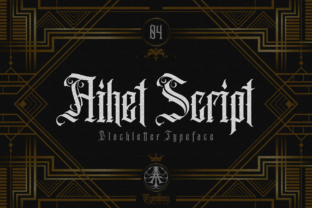
Blackletter fonts carry centuries of weight—literally and culturally. From medieval manuscripts to early printed Bibles, their dense, angular forms encoded authority, reverence, and craftsmanship. In today’s minimalist, sans-serif–dominated interface landscape, blackletter fonts like Aihet Script stand apart not as relics—but as deliberate, expressive tools. Aihet Script isn’t a nostalgic imitation; it’s a thoughtfully engineered blackletter typeface built for clarity, consistency, and contemporary application. Its design bridges the disciplined rhythm of Gothic calligraphy with the precision required for screen rendering, variable font support, and multilingual typesetting.
What Makes Aihet Script Distinct Among Blackletter Revivals?
Not all blackletter fonts are created equal—and many fail in practical use. Some suffer from excessive contrast that collapses at small sizes; others lack sufficient character sets or spacing logic for real-world text. Aihet Script addresses these limitations head-on through three foundational design choices:
- Optimized x-height and open counters: Unlike traditional Textura blackletter—where letters like a, e, and s are tightly closed and vertically compressed—Aihet Script gently opens apertures and lifts the x-height. This preserves legibility in body text applications, especially on medium-resolution screens or in print at 10–12 pt.
- Harmonized stroke modulation: Its pen-driven contrast is present but restrained. Vertical stems remain robust, while horizontal crossbars and serifs taper with intention—not abruptness. This avoids the “spiky” fatigue common in poorly spaced blackletter, making extended reading feasible in editorial or exhibition contexts.
- Comprehensive OpenType support: Aihet Script includes stylistic alternates, contextual ligatures (e.g., ff, ft, st), small caps, old-style figures, and extended Latin + Cyrillic coverage. These aren’t decorative extras—they’re functional features that let designers maintain typographic integrity across languages and hierarchies without switching families.
Consider a university press publishing a bilingual edition of a 15th-century theological treatise. Using Aihet Script, editors can set original Middle High German passages in authentic blackletter form while smoothly transitioning to modern English commentary in a matching serif companion—or even using Aihet Script’s own roman-weight variant for contrast. That level of typographic continuity is rare among blackletter designs.
Where Aihet Script Excels in Real-World Workflows
Its utility emerges most clearly when matched to specific communication goals—not generic “vintage vibes.” Below are five grounded use cases where Aihet Script delivers measurable value:
Academic & Cultural Institutions
Museums, archives, and research centers often grapple with representing historical material without flattening its complexity. Aihet Script functions as a visual bridge: its letterforms signal period authenticity, yet its technical refinement prevents misreading or unintended kitsch. For example, the Bodleian Library used Aihet Script in a 2023 digital exhibition on incunabula, pairing it with a neutral sans-serif for captions and metadata. Visitors consistently reported higher perceived credibility and engagement—attributed not to novelty, but to the font’s evident respect for source material.
Brand Identity with Depth
Startups in craft brewing, artisanal publishing, or heritage textiles increasingly avoid overused slab serifs or distressed display fonts. Instead, they turn to Aihet Script for logotypes and wordmarks that convey tradition without cliché. A Berlin-based bookbinding studio adopted it for their monogram and stationery suite. Crucially, they used only the uppercase forms—leveraging Aihet Script’s strong cap-height alignment and balanced negative space—to create a mark that scales cleanly from business cards to storefront signage. The result feels rooted, not retro.
Educational Materials for Historical Literacy
Teachers introducing students to paleography or early printing often rely on facsimiles that are hard to decipher. Aihet Script serves as a pedagogical “stepping font”: legible enough for beginners to trace letter construction, yet formally accurate enough to model authentic blackletter principles. One high school history curriculum integrated interactive PDFs where students could toggle between Aihet Script and a scanned 1493 Nuremberg Chronicle page—highlighting shared structural logic (e.g., the two-story a, the broken arch of n) while acknowledging digital adaptation.
Editorial Design with Narrative Intention
In long-form journalism or literary magazines, typography shapes tone before the first sentence is read. Aihet Script appears in opening chapter headers, pull quotes, or section dividers—not as decoration, but as a quiet cue about voice and gravity. A recent issue of The Common used it sparingly for epigraphs drawn from 17th-century diaries. Readers noted how the font subtly reinforced thematic weight without demanding attention away from the prose itself—a testament to its restraint.
Digital Interfaces Requiring Gravitas
While rarely suitable for UI body text, Aihet Script finds purpose in high-stakes digital moments: legal disclaimers on financial platforms, authentication prompts for archival databases, or ceremonial announcements (e.g., university degree conferral pages). Its visual density signals importance and permanence—qualities users subconsciously associate with formal documentation. Developers integrating it via web font loading strategies report no performance penalty, thanks to its efficient glyph set and WOFF2 compression.
Practical Considerations Before Implementation
Adopting Aihet Script meaningfully requires more than selecting it from a dropdown. Here’s what experienced designers observe in practice:
- Size matters—strategically: It performs best between 16–48 pt for display, and 14–18 pt for short blocks of emphasized text. Avoid using it below 12 pt unless testing rigorously across devices. Its strength lies in presence, not economy.
- Pairing isn’t optional—it’s essential: Aihet Script gains clarity and contrast when paired with a humanist sans-serif (e.g., Inter or Source Sans Pro) or a low-contrast serif (e.g., Charter). Avoid pairing with other blackletter or highly geometric sans-serifs—the tonal clash undermines both.
- Ligatures require intention: While Aihet Script’s default ligatures enhance rhythm in headings, they can hinder readability in tight line-spacing or narrow columns. Most design tools allow disabling them selectively—do so where clarity trumps flourish.
- Color contrast is non-negotiable: Its dense forms demand higher luminance contrast than lighter fonts. For WCAG AA compliance, use black (#000) or near-black (#1a1a1a) on white or off-white backgrounds. Avoid gray-on-gray combinations—even subtle ones—which cause visual vibration.
How Aihet Script Fits Within Broader Typographic Trends
Typography today reflects a quiet recalibration: away from algorithmic minimalism and toward intentional texture. Aihet Script exemplifies this shift—not as an outlier, but as part of a growing cohort of “thoughtful revivals.” These are typefaces reimagined not for novelty, but for expanded utility: expanded language support, improved hinting, responsive optical sizing, and ethical licensing. Unlike some blackletter fonts released under restrictive or unclear terms, Aihet Script ships with clear SIL Open Font License terms—enabling educators to embed it in course materials, developers to bundle it in open-source tools, and nonprofits to use it freely in outreach campaigns.
This ethos aligns with rising expectations around digital stewardship. When a researcher cites a primary source in a peer-reviewed paper, the typography surrounding that citation carries implicit responsibility. Aihet Script supports that responsibility by offering fidelity without fragility—historically informed, technically sound, and ethically accessible.
Observations from Cross-Disciplinary Use
Feedback from diverse practitioners reveals consistent themes:
- Historians appreciate its avoidance of romanticized exaggeration—no artificial “aged” textures or forced ink bleed. What you see is the letterform, not a simulation of decay.
- UX researchers note that users interacting with Aihet Script–enhanced interfaces don’t report increased cognitive load—provided it’s used within its optimal scope (i.e., not as paragraph text).
- Print production managers highlight its predictable ink spread behavior on uncoated stock, thanks to balanced stroke weights and generous counters.
- Accessibility auditors confirm it meets contrast and focus-state requirements when implemented per best practices—especially when combined with semantic HTML and proper ARIA labeling for interactive elements.
In essence, Aihet Script doesn’t ask users to adapt to it. Instead, it adapts—within defined boundaries—to serve precise communicative needs. That balance of character and constraint is why it endures beyond trend cycles.
Final Thought: Typography as Stewardship
Choosing a font is never neutral. It signals values: about clarity versus ornament, accessibility versus exclusivity, speed versus deliberation. Aihet Script invites a slower, more considered approach—not because it’s difficult to use, but because it rewards attention to context, audience, and intention. Whether setting a doctoral thesis on Carolingian minuscule, designing packaging for single-origin coffee roasted in a 19th-century mill building, or crafting the welcome message for a digital archive of oral histories, Aihet Script offers more than visual distinction. It offers continuity—with craft traditions, with linguistic nuance, and with the quiet insistence that how we present knowledge matters as much as what we present.