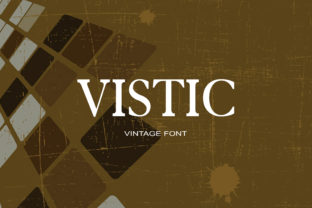
Vistic: Where Timeless Serif Elegance Meets Modern Design Sensibility
Typography isn’t just about legibility—it’s about voice, intention, and atmosphere. When you choose a font, you’re choosing a collaborator in storytelling. That’s why Vistic stands out: it’s a serif typeface that doesn’t lean on nostalgia for its appeal. Instead, Vistic reimagines the classic serif structure with clean proportions, subtle contrast, and a confident rhythm—making it feel both grounded and forward-looking.
What Makes Vistic Feel Modern—Without Losing Its Serif Soul
Serif fonts often carry associations with tradition—think law journals, luxury branding, or academic publishing. But Vistic sidesteps cliché by refining what matters most in today’s visual landscape: clarity at small sizes, versatility across devices, and expressive range without visual noise.
Its letterforms balance warmth and precision. The serifs are crisp but not sharp—slightly bracketed, gently flared—giving them presence without heaviness. The x-height is generous, supporting readability in UI interfaces and body text alike. And while many modern serifs sacrifice character for neutrality, Vistic retains personality: notice the elegant curve of the lowercase a, the graceful entry stroke of the g, or the open aperture of the e. These aren’t decorative flourishes—they’re functional details that guide the eye and support comprehension.
Where Vistic Shines in Real-World Projects
You don’t need to be designing a high-end fashion campaign to benefit from Vistic. Its adaptability makes it equally effective in contexts as varied as SaaS dashboards, editorial websites, boutique packaging, and even mobile app onboarding flows.
- Editorial & Publishing: In long-form digital reading, Vistic’s even color and open counters reduce fatigue. It pairs beautifully with minimalist sans-serif companions (like Inter or Manrope) for headings and captions—creating hierarchy without visual tension.
- Brand Identity Systems: Startups and creative studios increasingly seek typefaces that communicate credibility *and* approachability. Vistic delivers both: its structure signals thoughtfulness, while its light optical adjustments (like softened terminals and balanced stroke modulation) keep it feeling human—not robotic or overly academic.
- Product UI & Marketing Assets: Unlike some serifs that blur or pixelate at small sizes, Vistic includes carefully engineered screen-optimized variants. Whether it’s a tooltip label, a pricing card headline, or a testimonial pull quote, it remains crisp—even on mid-tier mobile displays.
Practical Pairing Strategies (That Actually Work)
Pairing fonts isn’t about contrast for contrast’s sake—it’s about creating intuitive visual relationships. With Vistic, successful pairings tend to follow one of two paths:
- The Balanced Duo: Combine Vistic (for headings, quotes, or hero text) with a neutral, highly legible sans-serif like Inter or Manrope for body copy and interface elements. This works because both share similar x-heights and low visual stress—so transitions feel natural, not jarring.
- The Expressive Layer: For more distinctive brand expressions, try pairing Vistic with a restrained geometric sans like IBM Plex Sans or Space Grotesk. The contrast here is intentional—serif warmth meets sans-serif clarity—but stays harmonious thanks to Vistic’s moderate stroke contrast and open forms.
Avoid overcomplicating things. If you’re building a landing page or redesigning a blog, start with Vistic for H1–H3 and your chosen sans for everything else—including buttons, form fields, and navigation. Test it at multiple sizes. You’ll likely find that Vistic holds up where other serifs falter: at 18px on a retina screen, at 24px in a dark-mode card, or even scaled down to 14px for subtle caption treatment.
Why Designers Are Choosing Vistic Over More “Established” Serifs
It’s easy to default to Georgia, Merriweather, or even newer favorites like Literata or Cormorant Garamond. But those fonts come with baggage—both technical and perceptual. Georgia was built for low-res screens in the 90s; Merriweather prioritizes ebook readability over UI flexibility; Cormorant leans heavily into high-contrast calligraphic influence.
Vistic, by contrast, was conceived for the hybrid environment we actually work in: responsive layouts, variable font support, mixed-media outputs (print + web + video), and tight design-system constraints. It ships with full OpenType features—including stylistic alternates, ligatures, and case-sensitive forms—so designers can fine-tune tone without switching families.
More importantly, Vistic avoids the “default serif” trap. It doesn’t scream “traditional,” nor does it whisper “experimental.” It occupies a thoughtful middle ground—confident enough for premium positioning, flexible enough for agile iteration.
Technical Considerations Before You Implement
Before dropping Vistic into your next project, consider these practical checkpoints:
- Licensing: Confirm whether your intended use (e.g., client website, SaaS platform, merchandise) falls under the license tier you’ve acquired. Some versions include web font hosting, variable axis support, or extended language coverage (e.g., Central/Eastern European, Greek, Cyrillic).
- Load Strategy: If self-hosting, serve only the weights and character sets you need. Vistic offers Light, Regular, Medium, SemiBold, and Bold—with optional Italic counterparts. Don’t load all six if your design only uses Regular and Bold.
- Accessibility Alignment: While Vistic performs well in WCAG contrast tests at standard sizes, always verify foreground/background combinations using tools like WebAIM’s Contrast Checker. Its generous x-height helps, but contrast remains contextual.
- Variable Font Support: If your stack supports variable fonts (modern browsers, CSS
@font-facewithfont-weightandfont-stretchaxes), Vistic’s variable version lets you interpolate weight smoothly—ideal for hover states, progressive disclosure, or dynamic typography systems.
How Vistic Fits Into Today’s Design Workflow
Modern design isn’t just about aesthetics—it’s about velocity, consistency, and scalability. Vistic integrates cleanly into Figma libraries, Adobe Fonts workflows, and CSS-in-JS theming systems. Its consistent metrics across weights mean spacing rules stay predictable. Its hinting and kerning tables are tuned for cross-platform rendering—so a headline looks nearly identical in Chrome, Safari, and Edge.
For teams managing design systems, Vistic reduces decision fatigue. Instead of debating between three serif options for “premium feel,” they adopt one that scales gracefully from tiny metadata labels to full-screen hero statements. That kind of reliability translates directly into faster iterations, fewer QA surprises, and stronger visual cohesion across touchpoints.
And for individual creators—freelancers, content writers, indie developers—Vistic offers something rare: distinction without complexity. You don’t need advanced typographic knowledge to use it well. Its built-in rhythm and proportion do much of the work for you.
Final Thought: Vistic Isn’t Just Another Font—It’s a Design Accelerator
In a world saturated with type choices, Vistic earns attention not by shouting, but by listening—to how people read now, where they read, and what emotional resonance they expect from the words in front of them. It respects tradition without being bound by it. It embraces modern constraints without sacrificing character.
Whether you’re refreshing a decade-old brand, launching a new product, or simply seeking a serif that feels fresh *and* familiar, Vistic delivers quiet confidence. It won’t distract. It won’t date quickly. And it will make your words feel worth reading—again and again.