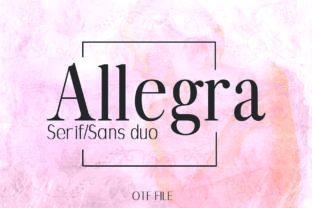
Allegra Duo: Serif + Sans, Seamlessly Paired
If you’ve ever spent hours hunting for two fonts that actually work together—not just sit side by side—then Allegra Duo isn’t just another font pair. It’s a thoughtful, cohesive solution built from the ground up: one elegant serif and one clean, confident sans serif, designed to share rhythm, proportion, and intent. No forced compromises. No awkward optical mismatches. Just two typefaces that breathe the same visual language.
A Typeface Duo That Feels Intentional, Not Assembled
The Allegra serif carries quiet authority—its high-contrast strokes, subtle bracketing, and refined terminals give it presence without pretension. Think editorial clarity meets timeless craftsmanship. It’s not overly dramatic like a Didone, nor too reserved like a traditional Garamond; it sits comfortably in modern publishing, luxury branding, and thoughtful web interfaces. The companion sans serif balances it perfectly: geometrically grounded but humanized with gentle curves, open apertures, and consistent x-height alignment. That shared x-height is key—it means headlines and body text scale cleanly, line heights feel natural, and hierarchy emerges effortlessly.
Together, they project approachable sophistication. Not cold minimalism. Not nostalgic revivalism. Something current, considered, and quietly confident. You’ll notice it in how the serif’s italic flows with purpose—not as decoration, but as emphasis—and how the sans’ medium weight holds its own in UI buttons or social media captions without shouting.
Where Allegra Duo Earns Its Keep (Beyond “Looks Nice”)
This isn’t a font duo for shelf appeal. It earns its place across real projects where legibility, tone, and consistency matter:
- Editorial design: Long-form articles, newsletters, or literary magazines benefit from the serif’s readability at small sizes and the sans’s crispness in pull quotes or section headers.
- Brand identity systems: Startups, boutique studios, or artisanal brands use the serif for logos or wordmarks (especially when paired with custom lettering), and the sans for supporting copy—ensuring cohesion across business cards, websites, and packaging.
- Web and app interfaces: With variable font support in many weights, Allegra Duo adapts well to responsive layouts. The sans works reliably down to 14px for interface labels; the serif shines at 18px+ for headings and feature text.
- Social media graphics & print collateral: From Instagram carousels to event posters, the duo gives designers flexibility without sacrificing polish. A serif headline over a sans caption feels intentional—not accidental.
Crucially, Allegra Duo avoids the common trap of “too much personality.” It doesn’t distract from content or brand voice. Instead, it reinforces it—whether that voice is calm and authoritative (a wellness brand), warm and articulate (a podcast or newsletter), or precise and trustworthy (a financial services firm).
Testing Fit Before Committing
Before licensing Allegra Duo, ask yourself three practical questions:
- What’s the dominant reading environment? If most users will see your content on mobile screens, test the sans in paragraph form at 16px on iOS and Android. Does spacing hold? Do characters like “a,” “e,” and “g” remain distinct? Allegra Duo’s sans was tuned for screen legibility—but your context matters more than the spec sheet.
- How much visual contrast do you need between hierarchy levels? Try setting a headline in serif Bold, subhead in sans Medium, and body in sans Regular. Does the jump feel clear but not jarring? If everything feels too similar, lean into weight contrast (e.g., serif ExtraBold + sans Light) rather than switching to a third font.
- Does your brand already have established color or imagery? Allegra Duo performs especially well against muted palettes, textured photography, or hand-drawn illustrations. It can feel stiff next to bold neon gradients or chaotic collage work—so preview mockups with your actual assets, not generic gray backgrounds.
You’ll also want to review the included styles. Most licenses include at least four weights per family (Light to Bold) plus italics—enough for nuanced hierarchy without overcomplicating your CSS or design system. If your project needs condensed or display variants, check whether those are part of the package or require an extended license.
Licensing, Realism, and What to Watch For
Allegra Duo is a premium font—meaning it’s professionally drawn, kerned, and hinted. That translates to fewer rendering surprises across browsers and devices. But “premium” also means licensing terms vary. For most small businesses and creators, the standard desktop + web license covers newsletters, Shopify stores, client websites (with proper attribution if required), and printed materials like brochures or business cards.
What requires extra attention? Embedded use in apps, e-books (EPUB), or SaaS platforms often falls outside standard terms. And while Allegra Duo isn’t a script or handwritten font—so it won’t suit whimsical children’s books or calligraphy-driven invitations—it’s remarkably versatile within its lane: modern, humanist, and structurally sound.
One final note: Don’t overlook the value of restraint. Allegra Duo works because it’s *just two* typefaces—not five variations of each. Resist adding a third “accent” font unless it solves a specific problem (e.g., a monospace for code snippets). Let the serif and sans carry the weight. Their balance is the point.
When Simplicity Is the Smartest Design Choice
In a world of endless font libraries and AI-generated “perfect pairings,” Allegra Duo stands out by doing less—and doing it well. It doesn’t try to be everything. It doesn’t chase trends. It gives you two reliable voices that speak clearly, consistently, and respectfully to your audience.
That makes it ideal for designers who value craft over clutter, entrepreneurs who need professional polish without hiring a full branding team, and content creators who want their words to land—not compete with their typography. Whether you’re laying out a quarterly report, designing a wedding invitation suite, or refreshing a blog’s visual identity, Allegra Duo offers confidence, not compromise.
It’s the kind of font duo you install once and reach for again—not because it’s trendy, but because it simply works.