Trian: The Vintage Serif That Anchors Design With Quiet Authority
Typography is rarely neutral. Even the most restrained typeface carries cultural residue, historical weight, and perceptual nuance. Trian is a case in point—not a loud or flamboyant voice, but one that speaks with the measured cadence of early 20th-century craftsmanship. Designed as a vintage serif, Trian doesn’t shout for attention; instead, it earns respect through structural integrity, subtle contrast, and a quiet sense of intentionality. Its presence on screen or paper signals thoughtfulness—not just in layout, but in how meaning is framed and delivered.
What Makes Trian Distinctively Vintage—Without Feeling Dated
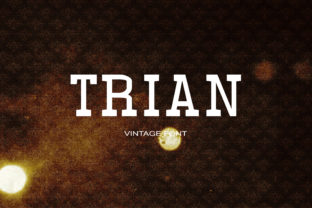
Trian draws from the typographic lineage of transitional and early modern serifs—think of the refined clarity of Baskerville or the sturdy dignity of Caslon—but avoids direct imitation. Its letterforms feature gently flared serifs, moderate stroke contrast (neither stark nor muted), and open apertures that support legibility across sizes and media. Crucially, Trian’s “vintage” quality isn’t achieved through distressing, ink bleed effects, or faux-aging. It resides in proportion, rhythm, and restraint: the slight asymmetry in the lowercase e, the tapered terminals on a and c, the balanced x-height that sits comfortably between traditional and contemporary norms.
This authenticity matters. In an era saturated with retro-inspired fonts that rely on ornamentation or nostalgia-as-aesthetic, Trian stands apart by prioritizing function alongside form. It doesn’t evoke a specific decade—it evokes a mindset: one rooted in material awareness, deliberate pacing, and respect for the reader’s eye. That’s why designers working on long-form editorial projects, academic publications, or brand systems built on trust often return to Trian—not as a stylistic flourish, but as a structural choice.
Where Trian Excels in Real-World Applications
Trian thrives where clarity, credibility, and continuity are non-negotiable. Its strengths emerge most clearly in contexts where text carries primary responsibility—not just decoration.
Editorial & Publishing Environments
From literary magazines to university press imprints, Trian supports extended reading without fatigue. Its generous counters and consistent spacing reduce visual noise, allowing readers to settle into content rather than navigate typographic idiosyncrasies. One independent publisher noted that switching their quarterly journal’s body text from a generic Garamond derivative to Trian resulted in a measurable drop in reported eye strain during proofreading—and an unexpected uptick in reader comments praising “the calmness of the page.” That calmness isn’t passive; it’s engineered.
Educational Materials & Research Documentation
In syllabi, white papers, annotated bibliographies, and research reports, Trian conveys authority without intimidation. Its even color on the page—neither too light nor too dense—makes dense information feel approachable. Educators using Trian in digital handouts report fewer student questions about formatting confusion, suggesting its predictability supports cognitive load management. For researchers compiling literature reviews or submitting grant proposals, Trian communicates rigor without rigidity—a subtle but meaningful distinction when competing for attention among dozens of submissions.
Brand Identity Systems Built for Longevity
Trian is rarely chosen for flash-in-the-pan campaigns. Instead, it anchors identities designed to evolve over years, not seasons. A regional museum rebranded using Trian for all signage, exhibition labels, and donor communications—not because it “looked old,” but because it communicated stewardship, permanence, and layered narrative. Similarly, a sustainable textile company adopted Trian across packaging, web copy, and lookbooks to reflect their commitment to time-tested methods and natural materials. In both cases, the font didn’t reference heritage as costume; it embodied continuity as practice.
Practical Considerations for Implementation
Adopting Trian effectively requires more than selecting it from a dropdown menu. Like any well-crafted tool, its value emerges through informed use.
- Pairing strategy: Trian pairs best with understated sans-serifs that share its warmth and proportion—think fonts like Lato, Nunito, or even a carefully scaled version of Inter—rather than high-contrast geometric types that clash tonally. Avoid pairing it with overly decorative or condensed fonts; Trian’s strength lies in its grounded neutrality, and competing personalities dilute its impact.
- Weight hierarchy: Trian offers a considered range—typically including Light, Regular, Semibold, and Bold—with optical sizing variants for display and text. Resist the urge to overuse bold weights. Its Semibold functions exceptionally well as a heading weight while preserving readability; the Bold is most effective at larger sizes for emphasis or short labels—not body text.
- Digital rendering: On screens, Trian performs reliably across modern browsers and operating systems. Its hinting is optimized for clarity at 16–22px sizes, and its letterfit remains consistent across variable-width displays. For responsive layouts, test line lengths: Trian’s ideal measure falls between 65–75 characters per line. Going significantly wider can weaken its rhythmic flow; narrower measures risk crowding its graceful serifs.
- Accessibility alignment: While not explicitly designed as an accessibility-first typeface, Trian meets WCAG 2.1 contrast requirements when used with appropriate background colors (e.g., #333 on #fff or #4a4a4a on #f8f8f8). Its clear glyph distinctions—especially between I, l, and 1—support users relying on visual parsing. For screen reader compatibility, always pair it with semantic HTML structure—not typographic styling alone.
Who Benefits Most From Choosing Trian?
The appeal of Trian extends beyond graphic designers. Its utility reveals itself differently depending on role and intent.
Content strategists appreciate how Trian shapes tone before a single word is read. Its presence subtly cues audiences to expect substance, not spectacle—making it a strategic asset in content-heavy industries like legal services, financial advising, or public policy.
Educators and curriculum developers find Trian valuable for creating inclusive, low-distraction learning materials. Students with dyslexia or visual processing differences often respond well to its open forms and consistent spacing—though individual needs vary, and Trian should be part of a broader accessibility toolkit, not a standalone solution.
Small business owners and artisans discover Trian helps communicate craft and care without resorting to clichéd “handwritten” or “rustic” tropes. A ceramicist using Trian on her website and product tags signals attention to detail and material honesty—qualities that resonate with customers seeking authenticity over trendiness.
Researchers and nonprofit communicators rely on Trian to present complex data, mission statements, or impact reports with gravitas and clarity. When advocating for systemic change or presenting longitudinal studies, typography that feels trustworthy—rather than trendy—reinforces message credibility.
Observations From the Field
Over several years of observing Trian’s use across diverse projects, certain patterns emerge—not as rules, but as recurring insights.
First, Trian rarely works well as a sole typographic element. Its quiet confidence gains resonance when paired with thoughtful whitespace, intentional line height (1.5–1.65 for body text), and deliberate margin structures. It rewards compositional discipline.
Second, its perceived “formality” is highly context-dependent. Used in a vibrant, image-forward food zine with warm paper stock and spot color printing, Trian reads as inviting and human-scaled. In a monochrome annual report for a tech ethics council, it reads as sober and principled. The font doesn’t impose tone—it responds to it.
Third, teams often underestimate how much Trian improves internal documentation. Engineering teams adopting Trian for API references and internal wikis report higher cross-team comprehension rates and fewer misinterpreted specifications—suggesting its legibility advantages extend beyond aesthetic preference into functional communication.
Looking Beyond Aesthetics: Trian as a Design Ethic
Ultimately, choosing Trian reflects a stance—not just about how something looks, but about how information should be treated. It assumes the reader’s time is valuable. It presumes complexity deserves clarity, not simplification. It honors tradition not as replication, but as dialogue across time.
That’s why Trian endures in environments where speed and virality hold little sway: archival interfaces, conservation project reports, poetry chapbooks, civic notices, and doctoral theses. These are spaces where lasting understanding matters more than immediate engagement—and where typography serves as infrastructure, not ornament.
For creators navigating an attention economy increasingly dominated by algorithmic feeds and fleeting formats, Trian offers something rare: permission to slow down, to prioritize coherence over novelty, and to build with materials that age gracefully—not because they’re antique, but because they’re soundly made.
Its vintage roots aren’t a limitation. They’re a foundation.