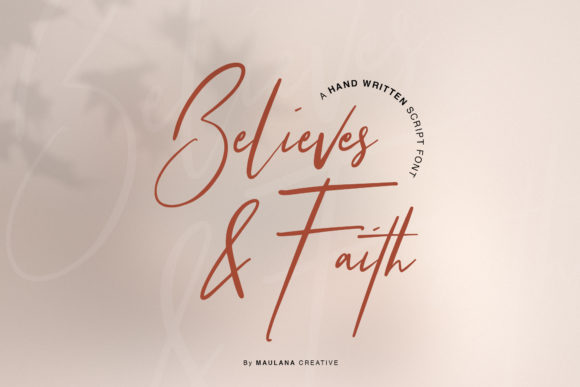
Believes and Faith: A Crafting Font That Anchors Design in Intention
Believes and Faith isn’t just another display font—it’s a deliberate design choice that signals care, clarity, and quiet confidence. Designed for creators who value substance over flash, it bridges the gap between typographic function and emotional resonance. Its smooth, unbroken lines and restrained elegance make it especially effective where authenticity matters: hand-lettered branding, artisan packaging, educational materials, personal journals, or any context where readers need to feel the human hand behind the work.
Where Believes and Faith Fits in Your Creative Workflow
Most fonts enter a project at the layout stage—after copy is written, images selected, and structure defined. Believes and Faith works differently. Because of its strong voice and intentional simplicity, it often plays a role earlier: during concepting, mood boarding, or even ideation. When you’re sketching a brand identity for a small-batch ceramics studio or drafting the cover for a mindfulness workbook, selecting Believes and Faith early helps align visual tone with core values before pixel or ink hits the page.
It also serves as a subtle quality checkpoint. If a headline set in Believes and Faith feels visually off—too cramped, too light, or disconnected from supporting text—it’s often a sign that the underlying hierarchy, spacing, or content framing needs adjustment—not the font itself. In this way, it functions less like decoration and more like a diagnostic tool for compositional integrity.
Using It Before the Project Begins
Before opening your design app, consider how Believes and Faith supports preparation. Its clean letterforms encourage thoughtful word choice. You’ll naturally edit copy to match its economy—removing filler words, tightening phrasing, and sharpening messaging. This makes it especially useful in brief-writing, pitch decks, or course outline development, where clarity directly impacts stakeholder alignment or learner engagement.
For educators building lesson plans or freelancers drafting client proposals, setting key headers or section titles in Believes and Faith during the outlining phase creates immediate visual stakes. It forces specificity: “What do I *actually* want this section to communicate?” rather than defaulting to vague placeholder language.
Integrating During Execution
During active design or publishing, Believes and Faith performs best when paired with highly legible, neutral companions—think Inter, Lato, or Source Sans Pro for body text. Its strength lies in contrast: a calm, confident headline against grounded, readable paragraphs. Avoid pairing it with other high-contrast or decorative fonts; that dilutes its handcrafted sincerity.
Use it consistently across touchpoints—not just logos or covers, but email headers, slide titles, or printed workshop handouts. Consistency here isn’t about repetition for its own sake. It’s about reinforcing a shared rhythm: the same quiet assurance in a PDF syllabus, a product label, and an Instagram story. That cohesion builds recognition without shouting.
Spacing matters. Believes and Faith thrives with generous line height (1.4–1.6) and slightly increased letter-spacing (10–20 units) in all-caps settings. Tight tracking undermines its openness; overly loose spacing fractures its flow. Test readability at real-world sizes: 24pt for print headlines, 32px minimum for web banners. If it loses warmth or legibility at those sizes, adjust weight or scale—not the font choice.
Applying It After Completion
Post-project, Believes and Faith supports reflection and iteration. When reviewing a completed website, brochure, or presentation deck, ask: does the typography support the intended emotional response? Does it feel grounded, not generic? Does it invite attention without demanding it? These questions are easier to answer when the font has clear personality—and Believes and Faith delivers that without ambiguity.
It also aids in version control. Because it’s distinctive yet restrained, using it across iterations (e.g., beta vs. final brand guidelines, draft vs. published curriculum) creates an instant visual cue for stakeholders. No need to annotate “this is the approved version”—the presence of Believes and Faith, applied correctly, signals intentionality and completion.
Compatibility and Practical Constraints
Believes and Faith is optimized for modern browsers and common design tools (Figma, Adobe Creative Cloud, Sketch). It includes standard Latin character sets, basic punctuation, and OpenType features like ligatures and stylistic alternates—but avoid overusing those. Its power comes from restraint, not ornamentation.
It’s not ideal for dense UI interfaces, data tables, or long-form editorial layouts where rapid scanning is essential. Reserve it for moments that benefit from pause and presence: a mission statement, a signature quote, a workshop title, or a handmade product tag. Using it everywhere weakens its impact—and risks misalignment with user expectations.
When exporting for web, serve it via variable font files if possible. That reduces load time while preserving fine-grained control over weight and width. For print, embed subsets if file size is a concern—but always include full character sets for editable assets like templates or style guides.
Workflow Integration Tips for Real Users
- For marketers: Use Believes and Faith in campaign hero headers and email subject lines—not just for aesthetics, but to reinforce brand voice before the reader even clicks. Its calm authority builds trust faster than aggressive or trendy alternatives.
- For educators: Apply it to weekly learning objectives or reflection prompts in digital courseware. Its gentle rhythm supports cognitive ease—helping students focus on meaning, not decoding.
- For small business owners: Set your store name, tagline, and “About” section headers in Believes and Faith. Paired with warm photography and minimal layout, it communicates craftsmanship without needing descriptive text.
- For freelancers: Include it in your proposal’s section dividers and project milestone labels. It subtly signals professionalism rooted in process—not just output.
- For hobbyists and journalers: Print or trace its letterforms as a starting point for hand-lettering practice. Its balanced proportions train the eye for consistent spacing and weight distribution.
Long-Term Use and Quality Control
Believes and Faith gains strength over time—not through novelty, but through reliable application. Track usage across projects: Where did it elevate clarity? Where did it feel forced? Keep a simple log—just date, context, and one-sentence observation. Over six months, patterns emerge: maybe it shines in wellness contexts but feels stiff in tech-adjacent work. That insight informs smarter future choices.
Revisit your use of it annually. Does it still reflect your current voice? Has your audience’s expectation shifted? Fonts age like strategies do—not because they break, but because context changes. Updating a logo or rebranding a course doesn’t mean abandoning Believes and Faith, but it may mean adjusting weight, color, or placement to keep its intent intact.
Ultimately, Believes and Faith earns its place not by being everywhere, but by being *right* where it lands. It doesn’t shout belief—it embodies it, quietly, consistently, and with unmistakable craft. That makes it less of a tool and more of a partner: one that asks you to slow down, choose deliberately, and build with intention—every time.