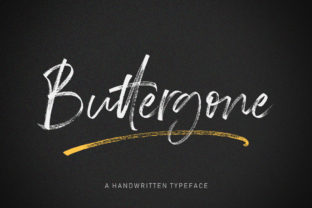
Buttergone: A Brush Font That Anchors Creative Intent in Real Work
Buttergone isn’t just another decorative typeface. It’s a brush font with intention—designed with an irregular baseline that resists uniformity without sacrificing legibility or impact. Its strokes carry weight and variation, but never randomness. That distinction matters: it means Buttergone doesn’t sit *on top* of your work—it integrates *into* it, supporting clarity while asserting personality. For professionals who balance authenticity with polish—whether designing a brand identity, crafting a workshop handout, or building a digital course—Buttergone functions as both tool and tone-setter.
Where Buttergone Fits in the Creative Workflow
Most fonts are selected at the end of a project—“just to make it look finished.” Buttergone works better when brought in earlier, often during the definition or refinement phase. When you’re clarifying a brand’s voice, sketching a presentation structure, or drafting copy for a landing page, applying Buttergone to key headers or section titles helps test whether the message feels grounded and human—not sterile or overproduced. Its irregular baseline subtly signals movement and responsiveness, which aligns well with brands emphasizing agility, craft, or learner-centered design.
It’s rarely used for body text—and that’s by design. Instead, Buttergone excels where emphasis meets authenticity: slide headlines, chapter openers, callout boxes, social media quote graphics, and even handwritten-style annotations in PDF workbooks. Because it avoids mechanical perfection, it pairs naturally with clean sans-serifs (like Inter or Manrope) or structured serifs (like Lora or Crimson Text). This contrast isn’t stylistic decoration; it’s functional hierarchy made visible.
Before the Project: Calibration, Not Decoration
Before opening Figma or starting a Canva template, spend five minutes testing Buttergone against your core messaging. Type out three variations of your main headline—each with slightly different phrasing—and apply Buttergone at 48pt, 36pt, and 28pt. Observe how the baseline shifts affect rhythm and pause. Does “Join Our Community” feel inviting? Does “Start Your First Module Today” feel urgent—or awkward? The irregular baseline introduces micro-timing into reading, so words land differently than they would in a rigid font. That’s not a bug—it’s feedback on your language.
This step also reveals compatibility early. Buttergone renders consistently across modern browsers and recent versions of Adobe apps, but older PDF viewers or legacy CMS editors may substitute fallback fonts if embedding isn’t handled. Always export final deliverables as PDF/X-4 or embed via @font-face with WOFF2 support. If you’re using Buttergone in Notion or Obsidian for internal planning, stick to headings only—avoid inline use in paragraph-heavy notes, where readability trumps flair.
During Execution: Consistency Through Constraint
Adopting Buttergone doesn’t mean applying it everywhere. In practice, consistency comes from restraint: define one primary use case (e.g., “all section headers in presentations”) and one secondary (e.g., “quote pulls in blog posts”). That boundary prevents visual fatigue and preserves impact. You’ll notice this especially in multi-page documents—when Buttergone appears only at structural inflection points (chapter starts, key takeaways, action prompts), readers subconsciously register those moments as meaningful pauses.
For teams, add Buttergone to your shared design system—but pair it with clear usage rules. Example: “Buttergone is permitted only in H1 and blockquote elements. Never in buttons, navigation, or data tables.” This isn’t limiting creativity; it’s protecting coherence. When freelancers hand off assets to clients or developers implement designs, those constraints reduce revision cycles and ensure the font serves its purpose—not just aesthetics.
Real-World Integration Examples
- Educators: Use Buttergone for weekly learning objectives in syllabi or slide decks. Its organic flow mirrors how people actually process goals—not as rigid checkpoints, but as evolving intentions.
- Small Business Owners: Apply it selectively to value proposition statements on homepages or service pages. Paired with neutral body text, it adds warmth without undermining professionalism.
- Bloggers & Content Creators: Reserve Buttergone for pull quotes pulled directly from interviews or personal reflections. The irregular baseline echoes the natural cadence of speech—making quoted material feel more present and less extracted.
- Productivity-Minded Users: In printed planners or Notion dashboards, use Buttergone for weekly focus themes (“Deep Work Week”, “Review & Reset”)—not daily tasks. It marks mental transitions, not to-do items.
After Delivery: Long-Term Usability and Quality Control
A font’s long-term value shows up in maintenance—not launch. Buttergone holds up well over time because it avoids trend-dependent quirks (no excessive swashes, no forced distortion). That means a brochure designed in 2024 will still feel intentional in 2027. But longevity depends on how you manage it. Store the OTF/WOFF2 files in your team’s shared assets folder with version notes (e.g., “Buttergone v1.2 – includes full Latin + diacritic support”). Avoid downloading from unverified sources; licensing terms vary, and some free versions omit critical glyphs or restrict web use.
When auditing existing materials—say, before a rebrand or platform migration—scan for accidental Buttergone overuse. Look for instances where it’s applied to low-salience elements (captions, footnotes, form labels). Those uses dilute its strength and introduce unnecessary rendering complexity. Replace them with your primary body font. Quality control here isn’t about removing personality—it’s about ensuring personality lands where it matters most.
Practical Tips for Smoother Implementation
- Test line height deliberately. Buttergone’s varying stroke depth means default line spacing often feels cramped. Increase line-height by 1.4–1.6x for display sizes above 32pt.
- Use color intentionally. Dark charcoal (#2D2D2D) or deep navy (#1A2B4C) reinforces gravity; avoid pure black (#000000), which can overwhelm its texture. For light backgrounds, skip pastel fills—stick to solid, muted tones.
- Pair with breathing room. Give Buttergone at least 24px of margin above and below in digital layouts. Its irregular baseline needs visual space to settle—not crowd.
- Export smartly for print. If using in physical materials, convert Buttergone text to outlines in Illustrator or InDesign before final PDF export. This prevents substitution if the printer’s system lacks the font.
- Document decisions. In your project brief or style guide, note why Buttergone was chosen—not just “it looks cool,” but “it supports our goal of balancing approachability with authority in customer-facing assets.” That reasoning becomes invaluable during stakeholder reviews or future audits.
Buttergone doesn’t replace strategy—it sharpens it. When you choose it, you’re not just picking a font. You’re choosing a way to signal that ideas have texture, execution has rhythm, and communication is rooted in real human attention. That makes it especially valuable for anyone whose work depends on trust, clarity, and sustained engagement—not just first impressions. Used with awareness and discipline, Buttergone stays useful far beyond the initial spark.