Camilla Ahoy: A Fun, Cool Handwritten Font
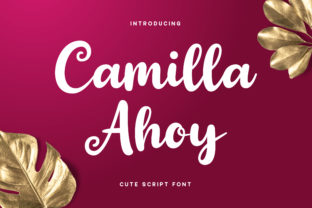
If you’ve ever spent 20 minutes scrolling through font libraries trying to find something that feels human—not stiff, not overdesigned, not tired—then Camilla Ahoy might be the quiet reset your design workflow needs. It’s not just another script font. Camilla Ahoy is an equally fun and cool handwritten font with a unique style: relaxed but intentional, playful but legible, casual but never careless. That balance matters—especially when your message depends on warmth, authenticity, or approachability.
Why handwriting still works—in digital spaces
Handwritten fonts like Camilla Ahoy tap into something deeply familiar. Our brains recognize natural variation—the slight tilt of a lowercase “a,” the soft pressure shift in a curved “g,” the subtle irregularity of baseline alignment—as signals of presence and personality. In a world saturated with uniform sans-serifs and over-polished display fonts, Camilla Ahoy offers visual breathing room. It doesn’t shout. It leans in.
This isn’t about nostalgia—it’s about resonance. A small business owner designing a seasonal email newsletter might choose Camilla Ahoy for the subject line because it quietly signals “this was made for you, not batched for everyone.” A teacher crafting printable classroom posters might use it for motivational quotes—its rhythm feels encouraging, not performative. And a freelance illustrator adding hand-lettered captions to social posts finds Camilla Ahoy saves time without sacrificing character: no redrawing needed, no tracing, no tweaking spacing to mimic organic flow.
Where Camilla Ahoy delivers real value
Camilla Ahoy shines where tone and texture matter more than technical precision. It’s built for short-form impact: headlines, callouts, product tags, Instagram story text, book chapter openers, podcast show notes headers. Its lowercase letters have gentle, rounded terminals; capitals carry just enough weight to anchor without dominating. The spacing is open—not tight like many scripts—so it remains readable even at smaller sizes (14–16px) on screens.
Consider a local bakery launching a new weekend brunch menu. Using Camilla Ahoy for the menu title (“Sunday Sunshine Brunch”) adds instant charm—no illustration required. Pair it with a clean, neutral sans-serif (like Inter or Lato) for body copy, and the hierarchy feels intuitive, not forced. The font does part of the emotional work so you don’t have to overexplain the vibe.
For educators and content creators, Camilla Ahoy also supports accessibility in practice—not compliance, but clarity. Its letterforms avoid extreme flourishes or overlapping strokes, reducing visual noise. That means students scanning a digital worksheet or readers skimming a blog sidebar won’t stumble over ambiguous shapes. It’s friendly without being childish, distinctive without being distracting.
Who benefits most—and why
Camilla Ahoy fits naturally into the toolkits of professionals who prioritize voice over velocity: bloggers refining their brand identity, indie publishers designing book interiors, small studio designers building client websites with soul, or solopreneurs creating print-on-demand stationery. It’s especially useful if you’re balancing multiple roles—say, a yoga instructor who also runs a wellness newsletter and sells printable affirmations. One consistent, expressive font helps unify those touchpoints without demanding custom illustration for every piece.
Freelancers often tell us they reach for Camilla Ahoy when clients ask for “something warm but professional”—a phrase that usually means “not corporate, not cutesy, not cold.” It answers that brief without requiring negotiation or revision rounds. You drop it in, adjust tracking slightly if needed, and move forward. That’s time saved—not just in design, but in alignment.
When to pause and consider alternatives
Like any handwritten font, Camilla Ahoy has thoughtful boundaries. It’s not ideal for long paragraphs, dense legal disclaimers, data tables, or interfaces requiring rapid scanning (think dashboard labels or form instructions). Its charm lives in contrast—not consistency across every element. If your project demands strict typographic hierarchy with three distinct weights or extensive language support (e.g., extended Latin, Cyrillic, Vietnamese), Camilla Ahoy may need pairing—or reconsideration.
Also worth noting: its uniqueness means it won’t blend invisibly into trends. That’s a strength for differentiation, but a consideration if you’re working within tightly governed brand systems (e.g., enterprise SaaS platforms with strict UI font stacks). In those cases, Camilla Ahoy works best as an accent—used sparingly in hero sections, testimonials, or branded assets—not as a system font.
Practical tips for using Camilla Ahoy well
- Pair intentionally: Match Camilla Ahoy with a neutral, highly legible sans-serif. Avoid other scripts or decorative fonts—they compete instead of complement.
- Limit scope: Use it for one key element per layout: a headline, a pull quote, a CTA button label. Let it breathe.
- Adjust tracking, not kerning: Slight letter-spacing (+10–20 units) often improves rhythm in all-caps usage or tight lines. Manual kerning is rarely needed.
- Test on devices: View samples on both desktop and mobile before finalizing. Its openness holds up well—but always verify at actual size.
- Respect context: A handmade greeting card? Perfect. A bank’s security alert banner? Not the right moment.
One underrated strength of Camilla Ahoy is how easily it adapts to different mediums. Print designers appreciate its ink-friendly curves and generous counters (the enclosed spaces in “o,” “e,” “a”). Digital creators benefit from its clean vector outlines—no pixelation, no hinting issues—even when scaled responsively. And because it’s a single-style font (not part of a sprawling family), there’s less decision fatigue. You’re not choosing between Light, Italic, Condensed, and Display variants. You’re choosing whether Camilla Ahoy fits—and if it does, it fits cleanly.
A quiet tool for meaningful expression
Great typography doesn’t draw attention to itself—it directs attention to the idea. Camilla Ahoy succeeds by doing just that: supporting meaning without overshadowing it. It’s the kind of font you notice only when it’s missing—when the tone feels flat, the connection feels distant, or the design feels like it’s trying too hard.
That’s why so many educators use it in student feedback comments—to soften critique without diluting clarity. Why podcasters embed it in episode title graphics—to signal intimacy before the first word is spoken. Why wedding stationers return to it season after season—not because it’s trendy, but because it consistently conveys sincerity.
In the end, Camilla Ahoy isn’t about decoration. It’s about intentionality dressed in ease. It’s for people who understand that how something looks influences how it’s received—and who’d rather spend less time wrestling with fonts and more time sharing what matters.