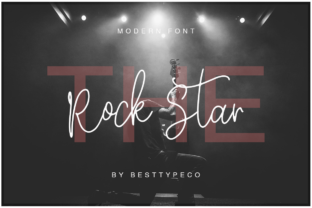
Rock Star: A Handwritten Font with Real Personality
If you've ever scrolled past a social post, landing page, or event flyer and paused—just for a second—because the text felt unexpectedly alive, you’ve likely encountered the quiet magic of a well-chosen handwritten font. Rock Star isn’t just another script; it’s a confident, expressive typeface that balances spontaneity with legibility, energy with intention. Designed for creators who value authenticity over polish, Rock Star brings warmth and rhythm to digital and print spaces where personality matters.
What Makes Rock Star Stand Out (Without Trying Too Hard)
At first glance, Rock Star feels effortless—like ink drawn with a slightly flexible nib. But look closer: its letterforms carry subtle variations in stroke weight, natural entry and exit flourishes, and carefully tuned spacing that avoids crowding without sacrificing flow. Unlike many decorative scripts that sacrifice readability at small sizes, Rock Star maintains clarity even at 14–16px on screen—making it viable for body copy in newsletters, blog headers, or mobile UI elements where tone and texture matter.
Its lowercase ‘a’, ‘g’, and ‘y’ feature open, friendly shapes—not overly stylized, but distinct enough to signal craftsmanship. Uppercase letters have presence without shouting: think bold invitations, not circus posters. And crucially, Rock Star includes full Latin character support, standard punctuation, numerals, and basic OpenType features like ligatures and contextual alternates—practical details that save time when designing across platforms.
Where Rock Star Fits in Real Workflows
You don’t need a branding agency or a design degree to get value from Rock Star. Its strength lies in versatility grounded in usability.
- Marketing & Social Content: Use Rock Star for Instagram story text overlays, email subject lines, or limited-run promo banners. It adds human rhythm to otherwise algorithm-optimized feeds—helping your message stand out without relying on stock imagery or filters.
- Educational Materials: Teachers and course creators use it for worksheet headers, learning path titles, or feedback notes in LMS platforms. Its approachable style reduces cognitive distance—especially helpful when introducing complex topics to adult learners or neurodiverse audiences.
- Small Business Branding: Cafés, boutiques, studios, and service providers often lean into Rock Star for signage mockups, packaging labels, or seasonal menus. It pairs cleanly with neutral sans-serifs (think Inter, Poppins, or Montserrat) for hierarchy—no clashing, no overdesign.
- Blog & Newsletter Design: Instead of defaulting to generic script fonts for section dividers or pull quotes, try Rock Star at 24–32px as a subtle anchor point. It creates visual breathing room while reinforcing voice—especially effective for opinion pieces, creator interviews, or reflective essays.
It’s Not Just About Looks—It’s About Intentional Communication
Typography is never neutral. Every font choice signals something—confidence, playfulness, authority, nostalgia. Rock Star communicates engaged authenticity. That’s valuable when your audience is skeptical of polished corporate messaging or fatigued by AI-generated uniformity. When a freelancer signs off a proposal with a Rock Star–styled “Thanks so much!”—it lands differently than Helvetica. It suggests care, attention, and a willingness to show up as a person, not a template.
This isn’t about chasing trends. It’s about matching tone to task. A financial advisor might avoid Rock Star for risk disclosures—but could use it tastefully in a client welcome guide or workshop title slide. A yoga studio might pair it with soft earth tones for retreat announcements, while a tech bootcamp might deploy it sparingly in student spotlight features to soften technical rigor with humanity.
Practical Tips Before You Implement
Like any expressive font, Rock Star works best when used with awareness—not excess.
- Test contrast early: On light backgrounds, its thinner strokes can fade if paired with low-contrast colors. Try #2D3748 or deeper charcoals instead of mid-grays for optimal legibility.
- Respect line length: At larger sizes (36px+), keep lines under 40 characters for headings. Longer blocks risk visual fatigue—even beautiful handwriting benefits from rhythm and rest.
- Pair thoughtfully: Avoid stacking multiple decorative fonts. Rock Star shines alongside clean, highly readable sans-serifs or modest serifs (e.g., Merriweather, Lora). Steer clear of other high-contrast scripts—they’ll compete, not complement.
- Check licensing scope: If you’re embedding Rock Star in client websites, SaaS dashboards, or downloadable PDFs, verify the license covers web font hosting, app embedding, or commercial redistribution. Some versions are desktop-only; others include WOFF2 and variable font options.
A Font That Grows With Your Projects
One underrated strength of Rock Star is how well it scales across formats. Print designers appreciate its crisp vector outlines for foil-stamped business cards or letterpress posters. Web developers find it lightweight and well-hinted—no jarring reflow on load. Presenters use it in Keynote or Google Slides without worrying about rendering inconsistencies across devices.
And because it avoids extreme exaggeration—no swooping tails that vanish on mobile, no ultra-thin hairlines that pixelate—it remains functional as your work evolves. That newsletter header? It’ll still read clearly in dark mode. That conference badge? It won’t blur when printed at 200dpi. That product label mockup? It holds up when scaled down for Amazon thumbnails.
Final Thought: Choose Tools That Reflect Your Voice
In a world saturated with interchangeable templates and generative assets, choosing a font like Rock Star is a small but meaningful act of curation. It says you care not just about what you communicate—but how it feels to receive it. Whether you're launching a side hustle, redesigning your portfolio, or crafting a thoughtful classroom resource, Rock Star offers more than aesthetic appeal. It offers resonance.
So next time you’re selecting type—not as an afterthought, but as part of your message’s foundation—consider what energy you want to extend. Then ask: does this font invite attention, or demand it? Does it feel like a handshake—or a handshake with a smile? With Rock Star, the answer tends to land somewhere beautifully in between.