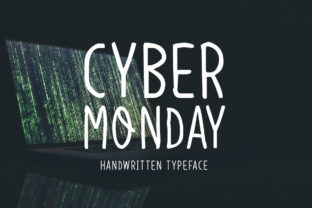
Cyber Monday: More Than Just a Shopping Day—A Cultural Moment with a Handwritten Heart
When most people hear “Cyber Monday,” they think of deep discounts, flashing countdown timers, and frantic cart-checkouts. But behind the buzz lies something quieter—and surprisingly human: Cyber Monday, the light and charming handwritten font with a casual, modern look. Yes—there’s a typeface named after the iconic shopping event. And no, it’s not a marketing gimmick. It’s a thoughtful design response to how digital culture balances efficiency with authenticity.
What Is Cyber Monday (the Font)?
Cyber Monday is a contemporary handwritten typeface designed to evoke spontaneity, friendliness, and approachability. Unlike rigid, geometric sans-serifs or formal serif fonts, Cyber Monday features soft curves, subtle inconsistencies in stroke weight, and natural-looking entry/exit strokes—just like ink flowing from a fine-tip pen. Its lowercase ‘a’ has a gentle loop; the ‘g’ leans playfully; the ‘t’ ends with a relaxed upward flick.
Despite its name, this font has nothing to do with e-commerce algorithms or server load spikes. Instead, it captures the spirit of Cyber Monday—the human energy behind the digital rush: the excitement of discovery, the warmth of shared deals among friends, the joy of clicking “buy” on something meaningful.
Why a Handwritten Font Named After a Shopping Holiday?
Font naming often reflects cultural resonance—not literal function. Designers choose evocative names to signal tone and context. “Cyber Monday” suggests immediacy, digital fluency, and lighthearted modernity. It’s a wink to our collective online rituals: the email alerts at midnight, the shared Google Sheets tracking wish lists, the Instagram Stories announcing flash sales.
This naming strategy works because it grounds abstract typography in real-life experience. When a small business owner selects Cyber Monday for their holiday newsletter, they’re not referencing retail logistics—they’re inviting readers into a moment that feels personal, timely, and unpretentious.
How Cyber Monday Fits Into Today’s Visual Language
In an age saturated with AI-generated graphics and ultra-polished UIs, handwritten fonts like Cyber Monday serve an essential emotional function: they reintroduce human texture. Research in cognitive psychology shows that viewers perceive handwritten type as more trustworthy, relatable, and memorable—especially in contexts involving care, creativity, or community.
- E-commerce: Boutique stores use Cyber Monday for limited-edition product tags or “Back in Stock!” banners—softening transactional messaging with warmth.
- Educational tools: Teachers embed it in digital worksheets or classroom newsletters to make learning feel inviting, not intimidating.
- Creative portfolios: Illustrators and lettering artists pair it with hand-drawn icons to reinforce authenticity in personal branding.
- Social media: Small creators apply it to Instagram carousel slides explaining “5 Things I Learned Launching My Shop”—blending expertise with approachability.
Dispelling Common Misconceptions
It’s easy to assume that handwritten fonts are “unprofessional” or “hard to read.” That’s a myth—especially with carefully crafted families like Cyber Monday. Let’s clarify:
- Myth: “Handwritten fonts don’t work for body text.”
Truth: Cyber Monday includes an optimized text variant with increased x-height and open counters—designed specifically for short paragraphs, captions, and mobile-friendly interfaces. - Myth: “It’s only for holiday-themed designs.”
Truth: Its versatility shines year-round—from farmers’ market flyers and indie podcast covers to wellness app onboarding screens. Its charm lies in context, not calendar constraints. - Myth: “All handwritten fonts look the same.”
Truth: Cyber Monday avoids clichés like exaggerated swashes or forced “childlike” irregularity. Its rhythm is deliberate—balanced between looseness and legibility.
Practical Tips for Using Cyber Monday Well
Like any expressive typeface, Cyber Monday thrives with intention—not excess. Here’s how to honor its design ethos:
- Pair thoughtfully: Contrast it with a clean, neutral sans-serif (e.g., Inter or Manrope) for headings + body combinations. Avoid pairing with other decorative fonts—it’s meant to be the friendly voice in the room, not part of a chorus.
- Respect hierarchy: Use its standard weight for headlines and medium weight for subheads. Reserve the lightest weight only for delicate accents—never for long blocks of text.
- Optimize for screen: At sizes below 16px, enable font smoothing and test contrast ratios. Cyber Monday’s soft edges benefit from slightly higher line height (1.4–1.6) on websites.
- Think beyond English: The font supports Latin-based languages (including accented characters for Spanish, French, and Portuguese), making it ideal for inclusive multilingual campaigns.
The Bigger Picture: Typography as Cultural Mirror
Cyber Monday the font reflects a broader shift in digital aesthetics—one where speed doesn’t have to mean sterility. As remote work normalizes video calls with imperfect lighting and “send” buttons replace face-to-face handshakes, audiences crave cues of humanity. A well-chosen handwritten font says, “I see you. This isn’t just data—it’s connection.”
That’s why designers increasingly reach for typefaces like Cyber Monday not just for seasonal campaigns—but for mission statements, nonprofit appeals, mental health resources, and even civic engagement tools. In each case, the goal isn’t decoration. It’s recognition: recognizing users as people first, customers second.
A Final Thought: Choose Type With Intention
You don’t need a design degree to appreciate the power of a single font choice. Whether you’re launching a Shopify store, drafting a community newsletter, or designing your first Canva presentation—pause before selecting “Poppins” or “Montserrat” by default. Ask yourself: What feeling do I want this message to carry?
If the answer is “welcoming,” “thoughtful,” or “genuinely excited”—Cyber Monday might be your quiet collaborator. It won’t shout. It won’t distract. But it will lend your words a heartbeat.
So next time you see Cyber Monday on a website banner or a handmade sticker pack, remember: it’s more than a name. It’s a reminder that even in our most digital moments, we still reach—for warmth, for clarity, and for the unmistakable signature of human presence.
Looking for accessible web font alternatives or tips on licensing Cyber Monday for commercial use? Check its official specimen page for technical details, language support, and usage guidelines.