Zahiya: A Sweet and Charming Script Font for Crafting Projects
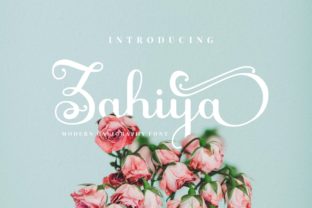
Zahiya is a hand-drawn script font designed with warmth, fluidity, and gentle contrast. Its letters feature soft entry and exit strokes, subtle irregularities, and a natural rhythm that evokes the feel of careful penmanship—without the stiffness of formal calligraphy. It is not a display font meant for headlines alone, nor a utility typeface built for dense body text. Instead, Zahiya occupies a thoughtful middle ground: a crafting font intended for expressive, small-scale applications where personality and approachability matter.
People often seek Zahiya when they’re working on physical or digital projects that benefit from a friendly, handmade aesthetic—think greeting cards, gift tags, scrapbook accents, wedding stationery, or social media graphics for small creative businesses. Its charm lies in consistency without rigidity: each character maintains visual harmony across weights and styles (where available), yet retains enough variation to avoid mechanical repetition. That balance makes it especially useful for designers and hobbyists who want typographic warmth without sacrificing legibility at moderate sizes.
Why Consider Zahiya?
Several practical factors make Zahiya worth evaluating alongside other script fonts. First, its letterforms are optimized for readability at 14–24 pt—unlike many decorative scripts that blur or collapse when scaled down. Second, Zahiya typically includes standard OpenType features such as ligatures, alternate characters, and contextual substitutions, allowing users to fine-tune spacing and flow without manual adjustment. Third, its design avoids extreme flourishes or overlapping connections, reducing the risk of unintended collisions in tight layouts.
For crafters using tools like Cricut Design Space, Silhouette Studio, or Adobe Illustrator, Zahiya’s clean vector outlines and well-spaced glyphs translate reliably into cut files and print-ready assets. Its lowercase-heavy structure supports common crafting phrases (“handmade with love,” “just for you,” “thank you”) without requiring excessive kerning or workarounds.
Key Benefits and Realistic Tradeoffs
The primary benefit of Zahiya is its emotional resonance. In contexts where tone matters—such as personal correspondence, boutique packaging, or community event signage—it communicates sincerity and care more readily than neutral sans-serifs or rigid serifs. It also scales predictably across formats: whether printed on kraft paper or rendered on a mobile screen, Zahiya retains its essential character.
However, those benefits come with tradeoffs. Zahiya is not suitable for long-form reading. Its connected script style limits its use in paragraphs or multi-line captions where clarity and scanning efficiency are priorities. It also performs poorly in low-resolution environments or at very small sizes (<10 pt), where stroke detail begins to merge or disappear. Users should expect to pair it intentionally—with a simple, highly legible sans-serif (e.g., Inter, Lato, or Montserrat) for supporting text—to maintain hierarchy and function.
Another consideration is language support. While most Zahiya variants cover basic Latin characters (A–Z, a–z, numerals, common punctuation), extended diacritics, Cyrillic, or Greek glyphs may be absent. If your project targets multilingual audiences—or includes names with accents—you’ll need to verify glyph coverage before committing to Zahiya as a primary type choice.
When Zahiya Fits Well
Zahiya shines in scenarios where authenticity and tactility are design goals. It works especially well for:
- Handmade product labels and jar tags, where typography reinforces artisanal values;
- Invitations and RSVP cards where warmth and personalization elevate perceived value;
- Digital stickers or printable planners aimed at creative learners and journalers;
- Social media posts for small studios, makerspaces, or local boutiques seeking cohesive, non-corporate branding;
- Classroom materials or children’s activity sheets where friendliness supports engagement.
In each case, Zahiya contributes to a unified impression—not by dominating layout, but by reinforcing intent through subtlety and cohesion. Its strength lies in reinforcement, not replacement: it enhances meaning already present in content and context.
When to Look Elsewhere
Zahiya is less appropriate when technical precision, broad accessibility, or strict brand neutrality are required. For example:
- If your project requires WCAG-compliant contrast and consistent letterform recognition—especially for readers with dyslexia or low vision—a more structured, open-sans script or even a carefully chosen sans-serif may serve better;
- If you’re designing UI elements, app interfaces, or data dashboards, Zahiya’s decorative nature undermines usability and violates common interface typography conventions;
- If your brand voice prioritizes authority, minimalism, or timelessness over approachability, fonts like Playfair Display (for elegance) or Source Sans Pro (for clarity) may align more closely with strategic goals;
- If budget or licensing constraints apply, verify Zahiya’s usage terms: some versions are free for personal use only, while commercial deployment may require a license—particularly for merchandise or client work.
Making a Practical Decision
Before selecting Zahiya, ask yourself three questions:
- What is the dominant medium? If output is primarily physical (paper, vinyl, fabric), test how Zahiya renders at actual size—especially with your intended printing method (inkjet vs. letterpress vs. laser engraving). Subtle stroke variations may behave differently across substrates.
- Who is the reader—and what do they need from the text? If the goal is quick comprehension (e.g., instructions, pricing, contact details), limit Zahiya to titles or short accent phrases. Let supporting text carry functional weight.
- How much time can you invest in refinement? Even well-designed scripts benefit from manual spacing adjustments in complex layouts. If your workflow favors speed over fine-tuning, consider a slightly more forgiving alternative like Quicksand (for friendly sans-serif energy) or Great Vibes (for a more traditional script with broader language support).
Also, compare Zahiya against similar fonts using real content—not just specimen words like “The quick brown fox.” Try setting your actual project text: a product name, a tagline, or a short quote. Notice where letters sit unevenly, where spacing feels loose or cramped, or where a word looks unintentionally ambiguous (e.g., “rn” versus “m”). These observations matter more than stylistic impressions alone.
Finally, remember that font choice is rarely about finding a “best” option—but about matching a tool to a specific intention. Zahiya doesn’t solve every typographic challenge. But when the challenge is to convey sincerity, craft, and quiet joy in a concise, tactile way, it offers a considered, capable response.