Diane Amorta: A Thoughtful Choice for Authentic Script Typography
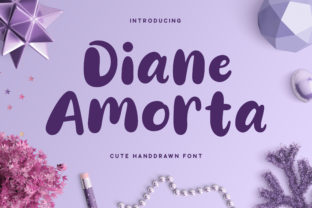
Diane Amorta is a hand-drawn script font designed to evoke the warmth and imperfection of real pen-on-paper lettering. It’s not a calligraphic flourish or a tightly kerned display face—it’s a quiet, approachable script that prioritizes natural rhythm over rigid symmetry. Each character carries subtle variation in stroke weight, slight slant inconsistencies, and gentle entry/exit terminals that mirror how a person writes with a flexible nib or fine-tip marker. That authenticity isn’t stylized; it’s baked into the design logic.
What Sets Diane Amorta Apart From Other Script Fonts
Many script fonts fall into one of two categories: highly formal (think wedding invitations with sharp flourishes and tight spacing) or overly casual (loose, bouncy, sometimes hard to read at smaller sizes). Diane Amorta occupies a middle ground—structured enough for clarity, relaxed enough to feel human. Its lowercase a, g, and y use single-story forms, which enhances legibility in body-sized applications like short captions or product tags. The uppercase letters avoid dramatic swashes, making them easier to mix with sans-serif or serif companions without visual tension.
Unlike script fonts built from vector-perfect curves, Diane Amorta includes intentional irregularities: slight wobble in horizontal strokes, uneven baseline alignment across characters, and varied spacing between certain letter pairs—not as a flaw, but as a feature. This makes it especially effective where polish might feel impersonal: small-batch packaging, artisanal brand identities, handwritten-style email headers, or editorial accents in lifestyle publications.
Where Diane Amorta Fits in Real-World Use Cases
It works best when the goal is warmth without whimsy. For example:
- A ceramic studio using Diane Amorta for its “Hand-thrown in Portland” tagline gains texture and sincerity—without leaning into cutesy or retro clichés.
- A wellness newsletter might apply Diane Amorta to section dividers (“This Week’s Insight”, “Your Practice”) to soften hierarchy while maintaining readability.
- An indie book publisher could set chapter titles in Diane Amorta paired with a neutral serif like Adobe Garamond—creating contrast that feels intentional, not jarring.
It’s less suited for long-form text, legal disclaimers, or interfaces requiring high scanability (like mobile app menus). Its charm lies in brevity and context—not endurance.
Comparing Approaches: When Simplicity Serves Better Than Complexity
Some designers reach first for highly ornate scripts—fonts with extended swashes, alternate glyphs, and contextual ligatures. Those have merit in specific contexts: luxury branding, event stationery, or logo lockups where every detail is curated. But Diane Amorta offers something different: restraint. It doesn’t ask users to navigate stylistic layers or toggle OpenType features. What you see in the basic character set is what you get—and that predictability saves time during layout, reduces rendering inconsistencies across devices, and lowers cognitive load for readers.
Compare that with script fonts relying heavily on discretionary ligatures (e.g., “fi”, “fl”, “ct” substitutions). While elegant in controlled environments, those can break unexpectedly in CMS fields, email clients, or multilingual content where glyph substitution isn’t supported. Diane Amorta avoids that risk by keeping its core set functional and stable—even when used in plain HTML text or basic PDF exports.
Practical Tradeoffs to Consider
No script font balances all needs equally—and Diane Amorta reflects deliberate choices, not oversights. Its simplicity means fewer stylistic options out of the box. There’s no bold weight, no italic variant (since it’s inherently slanted), and no condensed or extended versions. That’s an advantage for cohesion but a limitation if your project requires typographic contrast within the same family.
Also, because it’s optimized for authenticity over uniformity, tracking (letter spacing) needs attention. Tightening it too much risks crowding; loosening it too far disrupts the connected flow. Most designers find success with modest tracking adjustments (+10 to +30 units in design apps) rather than default settings.
Language support is another practical factor. Diane Amorta covers Latin-based languages thoroughly—including accented characters for French, Spanish, German, and Scandinavian languages—but doesn’t extend to Cyrillic, Greek, or non-Latin scripts. If your audience spans multiple writing systems, you’ll need fallback fonts or a broader type system.
When Diane Amorta Is Likely the Right Fit
Diane Amorta tends to align well with projects where voice matters more than versatility. Think of it as a reliable collaborator—not a Swiss Army knife. It fits naturally when:
- You’re building a brand identity centered on craft, care, or quiet confidence—not flash or trendiness.
- Your content strategy emphasizes tone over density—short headlines, social captions, product descriptors, or signature lines.
- You value consistency across platforms and want minimal font management overhead (e.g., no need to license multiple weights or manage variable axes).
- You’re pairing typefaces intentionally: Diane Amorta often pairs cleanly with humanist sans-serifs (like FF Meta or Nunito) or low-contrast serifs (like Lora or PT Serif), creating balance without competing personalities.
When You Might Look Elsewhere
Diane Amorta may not serve as well if your work demands:
- High information density: Dashboards, data reports, or technical documentation benefit from monospaced or highly legible grotesque fonts—not expressive scripts.
- Dynamic typographic expression: If you need bold/regular/light variants, optical sizing, or responsive width adjustments, a variable font or multi-weight family would offer more flexibility.
- Global language coverage: Projects targeting audiences using Arabic, Japanese, or Vietnamese script will require complementary type families, and Diane Amorta won’t anchor that system.
- Strict accessibility compliance: While readable at appropriate sizes, script fonts—including Diane Amorta—are generally discouraged for primary UI text or body copy under WCAG guidelines due to potential recognition variance among users with dyslexia or low vision.
Making a Grounded Decision
Choosing a script font isn’t just about aesthetics—it’s about alignment with purpose, audience expectations, and implementation reality. Diane Amorta stands out not because it does everything, but because it does one thing well: offering unpretentious, hand-informed lettering that feels grounded, not generic. It’s the kind of typeface that supports meaning instead of overshadowing it.
If you’ve tested it alongside alternatives—whether in mockups, live previews, or printed proofs—you’ll likely notice how it behaves differently at various sizes and in different color combinations. Try setting it at 24px over a soft beige background versus 18px in charcoal on white. Observe how the rhythm holds up in all-caps versus mixed case. These aren’t theoretical exercises—they’re ways to gauge whether Diane Amorta’s particular kind of authenticity resonates with your project’s needs.
Ultimately, the strongest typography decisions emerge from observation, not assumption. Diane Amorta invites that kind of attention: to spacing, to tone, to the space between intention and execution. When those elements converge, it doesn’t just look right—it feels like the right choice.