Ronallatie: An Elegant Monoline Handwritten Font for Thoughtful Design Choices
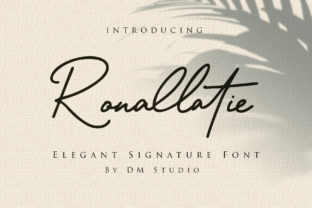
Ronallatie is an elegant monoline handwritten font—designed with consistent stroke weight, fluid rhythm, and subtle personality. Unlike calligraphic or brush-based scripts that rely on thick-thin contrast, Ronallatie achieves sophistication through restraint: each letter flows with quiet confidence, balancing naturalism and polish. It’s not a digitized scan of handwriting, nor a stylized decorative display face—it occupies a thoughtful middle ground where legibility meets expressiveness.
What Makes Ronallatie Distinctive?
Monoline fonts are often associated with simplicity or minimalism, but Ronallatie stands out by avoiding sterility. Its lowercase a, g, and s carry gentle, unforced idiosyncrasies—slight tapering at terminals, soft entry strokes, and organic spacing that feels hand-drawn without sacrificing consistency. Uppercase letters maintain the same even weight but introduce subtle directional cues: the R leans just enough to suggest movement; the T ends with a barely perceptible flick. These details aren’t arbitrary—they reflect deliberate craftsmanship aimed at evoking warmth and intentionality.
Unlike many script fonts that prioritize flourish over function, Ronallatie was built with real-world use in mind. It includes standard OpenType features like ligatures and contextual alternates—but they’re restrained, activated only where they improve readability or rhythm (e.g., smoothing the connection between f and i). There’s no forced swashiness, no exaggerated loops or dramatic exits. That makes it unusually versatile for applications where tone matters as much as typography: wedding stationery, boutique packaging, editorial pull quotes, or brand voice systems seeking authenticity without informality.
How Ronallatie Fits Among Handwritten and Script Fonts
When evaluating handwritten fonts, designers often weigh three dimensions: authenticity, legibility, and adaptability. Ronallatie leans toward the center of all three—not extreme in any direction, which becomes its strength in practice.
Compare it to highly expressive brush scripts: those excel in short-form impact (logos, social banners) but often falter in longer text blocks due to inconsistent spacing or competing visual weights. Ronallatie avoids that tradeoff. Its even line weight and open counters allow it to scale gracefully from 14pt body text in a printed brochure to 60pt headings on a website banner—without requiring manual kerning adjustments or fallbacks.
At the other end of the spectrum are ultra-minimal monoline fonts designed for technical clarity—clean, neutral, and sometimes emotionally distant. Ronallatie differentiates itself there too. It retains human texture: slight variations in curve tension, asymmetrical terminals, and a baseline that breathes rather than rigidly aligns. That nuance helps it feel personal without veering into casualness—a useful distinction when representing values like care, craft, or quiet confidence.
Practical Strengths—and Where It Has Limits
Ronallatie works especially well in contexts where tone must be both refined and approachable. A wellness brand using Ronallatie for its newsletter headlines signals thoughtfulness without clinical detachment. An independent publisher applying it to chapter titles in a literary journal adds quiet distinction without distracting from content. Even in digital interfaces, its even weight renders cleanly on screens, and its generous x-height supports readability at smaller sizes—unlike some delicate script fonts that blur or pixelate below 18px.
That said, Ronallatie isn’t optimized for every scenario. It lacks true small caps, alternate numerals, or multilingual support beyond basic Latin characters (no extended diacritics or Cyrillic variants). If your project requires robust language coverage, heavy typographic hierarchy (e.g., multiple weights for bold/medium/light), or tight integration with a sans-serif system that demands optical matching, you may need to pair Ronallatie intentionally—or consider alternatives better suited to those structural needs.
It also assumes a certain design literacy from the user. Because Ronallatie doesn’t “shout,” its subtlety can be lost if applied without attention to spacing, color contrast, or surrounding type. Pairing it with a crisp, neutral sans-serif (like a well-proportioned grotesk or humanist sans) usually yields stronger results than stacking it with another expressive face. And while its monoline nature gives it stability, it won’t provide the dynamic energy of a high-contrast script in contexts demanding vibrancy or urgency—think festival posters or youth-oriented campaigns.
Real-World Fit: When Ronallatie Aligns—and When It Doesn’t
Consider Ronallatie if:
- You’re designing for an audience that values understated quality—think artisanal goods, academic publishing, therapeutic services, or heritage brands updating their voice.
- Your layout balances text and whitespace intentionally, and you want typography that supports rather than competes.
- You need a handwritten aesthetic that remains legible across print and screen, and at varying sizes—from business cards to responsive web headers.
- You prefer working with fonts that behave predictably in layout software, without excessive manual tuning or glyph substitution surprises.
Reconsider Ronallatie if:
- Your project requires strong visual hierarchy through weight contrast (e.g., bold headlines vs. light body text)—Ronallatie is monoweight only.
- You’re building a multilingual site or publication with frequent accented characters, non-Latin scripts, or complex OpenType requirements (like stylistic sets for different languages).
- The brand voice leans heavily into playfulness, rebellion, or maximalism—Ronallatie’s elegance reads as calm, not energetic or disruptive.
- You’re working under tight deadlines with limited design resources and need a font that “just works” out of the box with minimal testing—its subtlety rewards attention but doesn’t auto-correct for poor implementation.
Making a Practical Comparison
Choosing a handwritten font isn’t about finding the “best” one—it’s about matching typographic behavior to functional and expressive goals. Ask yourself: What role does this font play? Is it carrying meaning, setting mood, or reinforcing identity?
Ronallatie excels when the goal is cohesion and quiet resonance. For example, a sustainable skincare brand might choose Ronallatie for product labels because its even weight conveys consistency and care, while its organic flow nods to natural ingredients—without resorting to clichéd leaf motifs or overly rustic textures. In contrast, a startup launching a gamified learning app might opt for a more animated, variable-weight script to mirror interactivity and growth—where Ronallatie’s composure could read as overly reserved.
Also consider how the font interacts with your existing toolkit. If your primary text face is a geometric sans-serif, Ronallatie’s warmth provides effective contrast without clashing. But if your system already relies on two highly expressive fonts, adding Ronallatie may dilute focus rather than deepen it. The strongest uses tend to be purposefully limited: a single headline treatment, a signature element in a logo lockup, or a recurring typographic motif in a seasonal campaign.
Final Considerations for Informed Use
Ronallatie invites intentionality—not just in selection, but in application. Its value emerges most clearly when paired with thoughtful layout decisions: generous line height, careful tracking adjustments, and mindful color choices that honor its delicate contrast. It’s not a plug-and-play solution, but neither is it fragile. With moderate testing across formats, it delivers reliable performance and distinctive character.
As with any typeface rooted in handwriting, context shapes perception. Ronallatie reads differently on matte paper versus glossy stock, in charcoal gray versus deep navy, beside a tight sans-serif versus a flowing serif. That responsiveness is part of its appeal—but it means evaluation shouldn’t happen in isolation. Test it in your actual layout, at real sizes, alongside your other assets.
Ultimately, Ronallatie suits designers and teams who see typography not just as decoration, but as a calibrated tool—one that communicates as much through what it omits as what it includes. If your work values clarity, coherence, and a human-centered sensibility, Ronallatie offers a quietly compelling option worth exploring alongside other approaches.