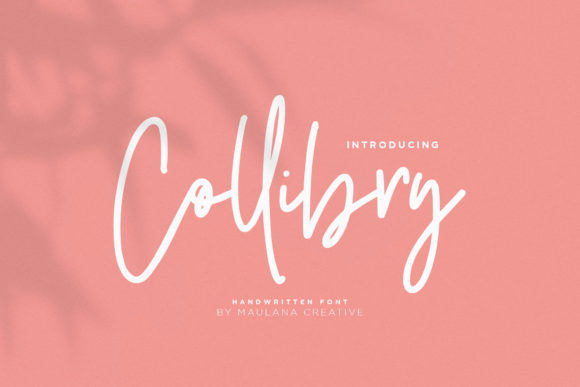
Collibry: A Handwritten Font for Organic, Human-Centered Design
Collibry is a carefully crafted handwritten font designed to evoke authenticity, warmth, and tactile presence. Unlike rigid geometric or highly polished typefaces, Collibry features subtle irregularities—varied stroke widths, slight letter tilts, and natural entry/exit flourishes—that mimic real pen-on-paper writing. It is not a script font meant for formal calligraphy, nor is it an ultra-decorative display face. Instead, Collibry occupies a thoughtful middle ground: legible enough for short headlines and captions, expressive enough to convey personality, and grounded enough to feel intentional rather than arbitrary.
Why Designers Consider Collibry
Designers often seek type that reinforces—not competes with—their message. When the goal is to communicate approachability, craft, sustainability, or personal connection, typography becomes part of the narrative. Collibry appeals to those working in contexts where “handmade” isn’t just an aesthetic choice but a value signal—such as artisanal food packaging, independent publishing, wellness branding, or educational materials aimed at younger audiences. Its organic rhythm supports visual storytelling without demanding attention for its own sake.
It’s also valued for its relative versatility within its category. Many handwritten fonts sacrifice readability at smaller sizes or in longer passages; Collibry maintains clarity down to ~16px in well-lit digital interfaces and holds up reliably in print at 14–18pt for body copy in brochures or zines. That balance makes it practical—not just decorative.
Key Benefits—and Realistic Expectations
Authentic texture without visual noise. Collibry avoids excessive embellishment. Its baseline consistency and moderate x-height prevent the “wobbly” fatigue some script fonts induce over time. This contributes to sustained legibility, especially in mixed-font layouts where it serves as a primary headline paired with a neutral sans serif for supporting text.
Human rhythm, not randomness. Each character was drawn by hand, then refined digitally to preserve nuance while ensuring typographic cohesion. The result feels intentional—not algorithmically generated or overly uniform. That intentionality matters when building brand recognition: viewers subconsciously register consistency even in informal type.
Lightweight file size and broad format support. Available in standard OpenType (.otf) and web-optimized WOFF2 formats, Collibry integrates smoothly into modern design workflows—whether used in Figma for mockups, Adobe applications for print production, or CSS @font-face declarations for websites.
That said, expectations should be grounded. Collibry is not optimized for dense paragraphs or data-heavy interfaces. It lacks extensive language support beyond basic Latin characters (no Cyrillic, Greek, or extended diacritics), and its stylistic alternates are limited—meaning less flexibility for fine-tuning tone across multilingual or highly nuanced content. Users needing robust OpenType features like contextual ligatures or small caps will find Collibry minimal in that regard.
When Collibry Fits Well
Collibry excels in projects where tone and context align closely with its inherent qualities:
- Branding for small creative businesses—bakeries, ceramic studios, botanical shops—where visual identity emphasizes care, locality, and tactile quality.
- Educational or therapeutic resources aimed at children or neurodiverse audiences, where softer, less rigid forms reduce cognitive load and increase emotional resonance.
- Digital newsletters or landing pages that prioritize warmth and invitation over speed or scalability—especially where audience trust hinges on perceived sincerity.
- Print collateral with short textual elements, such as greeting cards, recipe inserts, or event posters, where each word carries weight and space is intentionally generous.
In these cases, Collibry functions less as “just a font” and more as a quiet contributor to voice and atmosphere—complementing photography, illustration, and layout decisions rather than dominating them.
When Alternatives May Be More Suitable
Collibry may fall short in scenarios requiring broader functional demands. For example:
- If your project spans multiple languages—including non-Latin scripts—fonts like Quicksand (with extended language coverage) or Lexend (designed for readability across diverse populations) offer stronger international support.
- If you need high contrast between heading and body text *within the same family*, consider dual-axis variable fonts like Vollkorn or Merriweather, which provide matching serif/sans combinations with consistent proportions and spacing.
- If accessibility is a top priority—particularly for low-vision users—Collibry’s modest x-height and connected strokes may reduce legibility compared to dyslexia-friendly options like OpenDyslexic or Sans Forgetica, which use deliberate spacing and weight variation to aid retention.
- If your workflow relies heavily on dynamic text generation (e.g., automated reports or CMS-driven product labels), Collibry’s lack of extensive OpenType features or monospaced variants could limit automation efficiency versus system fonts or widely licensed alternatives.
Making a Practical Decision
Before committing to Collibry, test it in your actual context—not just in isolation. Ask yourself:
- What is the primary role of text in this project? If it’s to guide, inform, or instruct efficiently, Collibry works best in supporting roles (headlines, pull quotes, callouts). If text is central to user action—like form labels or navigation menus—pair it with a highly legible companion font and avoid using it alone.
- Who will read it—and under what conditions? Test Collibry on mobile devices in ambient light, and at typical viewing distances. Observe whether letterforms remain distinguishable, especially lowercase a, e, and s, which can blur together in less-differentiated handwritten styles.
- Does your brand voice stay coherent across touchpoints? Try Collibry alongside your logo, imagery, and color palette. Does it reinforce—or inadvertently contradict—your intended impression? A mismatch isn’t about “good” or “bad” type, but alignment with strategic intent.
- What’s your technical scope? Confirm licensing terms match your use case (e.g., desktop-only vs. web embedding vs. app bundling). Some versions of Collibry require separate licenses for commercial redistribution, which matters for agencies or SaaS platforms.
Ultimately, Collibry is most effective when chosen deliberately—not because it’s trending, but because its specific qualities serve a defined purpose. It won’t solve vague design challenges, but it can meaningfully strengthen communication where human warmth, craft, and authenticity are essential to the message.