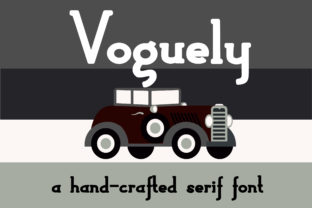
Vogueuly: A Handcrafted Serif That Finds Its Place in Real Design Work
When you’re choosing a font for a project, you’re not just picking letters—you’re selecting tone, intention, and quiet confidence. Vogueuly is a handcrafted serif font built with that understanding at its core. It’s not designed to disappear into the background or shout for attention. Instead, it carries a distinct personality: refined but approachable, traditional yet quietly modern, precise but never rigid. Its letterforms show subtle irregularities—the kind you’d expect from skilled penmanship—not flaws, but evidence of human care.
Where Voguely Fits Naturally (Without Forcing It)
Vogueuly thrives where authenticity matters more than uniformity. Think of it as the typeface you reach for when your audience values craft over convenience—when “designed” should feel intentional, not algorithmic.
Editorial & Long-Form Storytelling
Magazines, literary journals, and independent newsletters often struggle to balance readability with voice. Vogueuly handles body text beautifully at 14–16pt, especially on quality paper or well-calibrated screens. Its generous x-height and open counters keep lines flowing without fatigue, while its slight contrast and soft serifs lend warmth to serious topics—from climate essays to personal memoirs. One editor we spoke with used it across a quarterly print publication focused on regional food culture; readers consistently commented on how “inviting” the typography felt—even before they read a word.
Branding for Thoughtful Businesses
Small studios, ceramicists, bookshops, natural skincare lines, and artisanal bakeries often avoid overly polished fonts because they clash with their values. Vogueuly bridges that gap. It conveys heritage without leaning into cliché (no faux-vintage distressing), and sophistication without coldness. A Brooklyn-based letterpress studio uses it for business cards and workshop posters—it reads as confident but never corporate. Similarly, a Tasmanian tea brand chose Vogueuly for its packaging typography: the font’s gentle rhythm echoes the slow, intentional process behind each blend.
Digital Interfaces with Personality
Yes—serifs *can* work well online, especially when legibility and emotional resonance are priorities. Vogueuly shines in carefully controlled UI contexts: portfolio sites for illustrators and typographers, boutique hotel booking pages, or even the “About” section of a therapist’s website. Its measured spacing and clear hierarchy help guide users without overwhelming them. Just avoid using it below 16px for interface labels or buttons unless you’ve tested contrast and loading performance—its fine details need room to breathe.
Who Benefits Most—and How
- Independent designers appreciate how Voguely reduces the need for heavy visual styling. A clean layout + Vogueuly often feels complete—no extra textures, gradients, or animations needed. It lets the work speak first.
- Content creators launching newsletters or Substacks find it refreshingly different from default system fonts or overused Google Fonts. Readers notice the difference in tone—subtly signaling care and consistency.
- Print-focused small businesses love its strong ink spread behavior. Unlike ultra-thin serifs that risk filling in during offset printing, Vogueuly’s stroke weight holds up reliably across uncoated stocks and letterpress impressions.
- Educators and writers publishing zines or chapbooks value its licensing flexibility and straightforward OpenType features—ligatures and alternate characters are present but optional, so you can keep things simple or add nuance depending on the project’s needs.
What to Consider Before You Use It
Vogueuly isn’t a universal solution—and that’s part of its strength. Here’s what thoughtful users keep in mind:
- It’s not built for high-density data displays. Avoid using it for spreadsheets, dashboards, or multi-column technical documentation where speed of scanning matters most. Its charm lies in pause, not pace.
- Web performance depends on how you serve it. Like most well-crafted display serifs, Vogueuly comes in multiple weights and styles—but loading every variant adds latency. Pick only the weights you’ll actually use (e.g., Regular + Italic, or Regular + Bold), and serve them via modern
@font-facedeclarations withfont-display: swap. - Pairing works best with restraint. Vogueuly doesn’t need a “contrast partner.” Try pairing it with a neutral sans like Inter or a modest geometric like Poppins—but only if your layout truly calls for two type families. Often, Vogueuly alone—across weights and sizes—is enough.
- Language support is thoughtful, not exhaustive. It covers Latin-based languages thoroughly (including extended diacritics for French, Spanish, Vietnamese, Turkish), but doesn’t include Cyrillic, Arabic, or CJK glyphs. If your audience spans those scripts, plan for graceful fallbacks or complementary fonts.
Strengths That Show Up in Daily Use
Vogueuly’s handcrafted nature pays off in ways that aren’t obvious in specimen sheets. Its lowercase a, g, and y have distinctive shapes that improve word recognition at a glance—helpful in headlines or pull quotes. The italic isn’t just slanted; it’s redrawn with calligraphic flow, making emphasis feel earned rather than automatic. And its punctuation—especially the comma and em dash—has just enough weight and curve to support rhythm in long sentences.
One unexpected benefit? Printers report fewer kerning adjustments are needed during preflight. The spacing was tuned with real-world typesetting in mind—not just screen previews. That saves time when you’re juggling final proofs and tight deadlines.
When Another Font Might Be a Better Fit
Vogueuly isn’t ideal if you need extreme scalability (think stadium signage or tiny mobile app icons), ultra-narrow widths for tight layouts, or strict WCAG AAA contrast compliance out-of-the-box. Its contrast ratio meets AA standards comfortably at standard sizes—but for users relying on high-magnification tools or low-vision settings, test it in context. Also, if your brand voice leans into bold minimalism, tech-forward clarity, or playful irreverence, Vogueuly’s quiet confidence might under-deliver. That’s not a flaw—it’s alignment. Choosing wisely means knowing when *not* to use it.
A Font That Grows With Your Projects
Many fonts feel like costumes—great for one campaign, awkward for the next. Voguely behaves more like a reliable tool: it adapts without losing identity. Use it for a wedding invitation suite, then shift seamlessly to a brand’s annual impact report. Apply it to a limited-edition poetry chapbook, then reuse its rhythm in a gallery exhibition guide. Its consistency isn’t repetitive—it’s cohesive.
That cohesion comes from intention, not automation. Every curve in Vogueuly was drawn, adjusted, and tested—not generated. And that shows up where it counts: in the quiet confidence of a well-set paragraph, the trust signaled by a thoughtfully branded business card, and the calm clarity of a website that doesn’t shout to be seen.