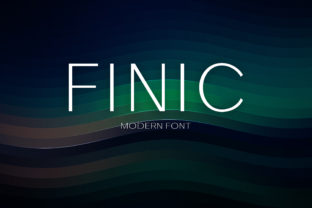
Finic: Where Typographic Clarity Meets Quiet Confidence
Typography is rarely about the letters alone—it’s about the space between them, the weight they carry in context, and the unspoken tone they project before a single word is read. Finic doesn’t shout. It doesn’t mimic trends or lean heavily on optical tricks. Instead, it offers something increasingly rare in today’s saturated design landscape: a sans serif font with quiet authority—balanced, legible, and unmistakably itself. Built for readability without sacrificing character, Finic stands apart not through ornamentation, but through intentionality in its proportions, rhythm, and spacing.
A Design Language Rooted in Restraint
At first glance, Finic appears familiar—a clean, contemporary sans serif—but closer inspection reveals thoughtful departures from convention. Its lowercase a and g use a single-story construction, lending consistency and openness at small sizes. The terminals of strokes are subtly flared—not blunt, not rounded, but gently tapered—creating a soft visual cadence that eases extended reading. The x-height sits comfortably above average, improving recognition in body text, while the cap height remains grounded, avoiding the top-heavy tension found in many high-x-height fonts.
What makes Finic especially effective across devices is its generous letter-spacing by default. Unlike fonts that require manual tracking adjustments for digital interfaces, Finic’s built-in rhythm holds up well on low-resolution screens and at variable widths—from narrow mobile viewports to wide editorial layouts. This isn’t accidental; it reflects a deep understanding of how typography functions in real-world conditions, not just idealized mockups.
Who Finds Value in Finic—and Why
Finic resonates across disciplines—not because it tries to be everything to everyone, but because its strengths align with practical needs shared by diverse users.
- Educators and instructional designers choose Finic for learning materials where cognitive load matters. Its even color, open counters, and consistent stroke contrast reduce visual fatigue during long study sessions—especially important for students with dyslexia or visual processing differences. One university’s accessibility office reported a measurable improvement in comprehension scores when switching from generic system fonts to Finic in their online course reader.
- Product teams and SaaS developers integrate Finic into dashboards and admin interfaces where clarity trumps flair. Its numerals are tabular and monospaced by default, making data tables instantly scannable. The punctuation—particularly the period and comma—is sized and positioned to avoid “floating” or disappearing at small sizes, a subtle but critical detail when error messages or status labels must be understood at a glance.
- Independent publishers and literary journals use Finic for digital-first editions where voice and tone must remain intact across formats. Its italic is a true oblique—not a slanted roman—with adjusted letterforms that preserve rhythm and legibility. That distinction matters when typesetting poetry or essays where line breaks and emphasis carry semantic weight.
- Brand strategists and identity designers turn to Finic when building systems that prioritize longevity over virality. Its restrained personality allows brand color, imagery, and voice to lead—while still providing typographic cohesion. A regional museum rebranded using Finic as its sole text face across signage, web, and print; visitors consistently described the experience as “calm,” “trustworthy,” and “unhurried”—attributes directly tied to the type’s measured pacing and lack of visual aggression.
Real-World Behavior Across Environments
Finic performs differently depending on context—not because it’s inconsistent, but because it’s engineered to adapt intelligently. In print, its ink spread characteristics are optimized for offset and digital presses alike. The slightly heavier hairlines prevent vanishing on coated stock, while the open apertures resist filling in on newsprint. That same attention informs its web behavior: the font includes robust hinting for Windows ClearType and advanced OpenType features like contextual alternates and discretionary ligatures—activated only where they improve flow, never where they distract.
Consider a healthcare portal redesign. Engineers needed a typeface that would render reliably across legacy tablets used in clinics, modern kiosks in waiting rooms, and staff laptops running varied OS versions. Finic’s broad language support—including extended Latin, Greek, Cyrillic, and basic Vietnamese—meant one font file could serve multilingual patient instructions without fallbacks triggering layout shifts. More importantly, its vertical metrics were designed to align cleanly with common CSS baseline grids, eliminating unpredictable line-height jumps during dynamic content loading.
Working With Finic: Practical Considerations
Adopting Finic doesn’t require overhauling your entire design system—but it does invite reconsideration of hierarchy and scale. Because Finic avoids extreme contrast between weights (its Light to Bold progression is steady, not dramatic), visual emphasis relies more on size, spacing, and context than weight shifts alone. Designers often find they need less bold text to signal importance; instead, a modest increase in font size paired with increased line height yields stronger, more accessible contrast.
Its variable font version adds another layer of utility. Rather than loading six separate static files, teams can serve a single finic-variable.woff2 and adjust weight, width, and optical size programmatically. For example, a responsive navigation bar might use a condensed width at small breakpoints, then expand to normal width on desktop—without swapping fonts or breaking alignment. Or a blog’s article title could scale its optical size based on viewport width, ensuring optimal legibility whether viewed on a foldable phone or a 32-inch monitor.
That said, Finic isn’t universally ideal. Its restrained nature means it may feel understated in contexts demanding immediate visual impact—such as festival posters or high-energy social ads. It also lacks decorative variants (no inline, no stencil, no distressed styles), which is intentional: it’s built for communication, not decoration. Users expecting a “Swiss-style chameleon” may overlook its strength—its consistency across roles.
How Finic Fits Into Broader Typographic Trends
Finic arrives amid a quiet shift in type culture: away from maximalist experimentation and toward what some call “responsible legibility.” This isn’t a retreat from creativity—it’s a recalibration. As screen time increases and attention fragments, typefaces that prioritize function *without* sacrificing aesthetic integrity gain relevance. Finic reflects this ethos: it’s not minimal because it’s stripped down, but because every element serves a perceptual purpose.
Compare it to other widely used sans serifs. Helvetica excels in neutrality but can feel cold at small sizes due to tight apertures. Inter was built for UI legibility but leans heavily on functional geometry, sometimes at the expense of warmth. Finic occupies a middle ground—structured enough for systems, human enough for storytelling. Its lowercase e, for instance, has a gently curved crossbar that guides the eye horizontally without drawing attention to itself. That’s not novelty—it’s craft.
Implementation That Respects Real Constraints
For developers integrating Finic, the most impactful step isn’t technical—it’s typographic hygiene. Start by defining clear usage rules: Which weights serve headings? Which handle captions? Does body text use regular or medium? Finic’s weight naming (Thin, Light, Regular, Medium, SemiBold, Bold) avoids ambiguity—so leverage that precision. Avoid applying font-weight: bold generically; instead, assign font-weight: 600 explicitly to ensure the correct SemiBold instance loads.
CSS custom properties make scaling intuitive. Define --font-size-body: 1rem; and --line-height-body: 1.5;, then adjust those values per breakpoint rather than overriding individual elements. Finic’s natural metrics mean these global adjustments propagate cleanly—no need for per-element margin-top fixes to compensate for erratic line heights.
And for content creators: write with Finic’s rhythm in mind. Short paragraphs. Strategic line breaks. Avoid all-caps subheadings—Finic’s uppercase letters are designed for initial caps and acronyms, not extended blocks. Let its inherent balance do the work.
Not Just Another Font—A Framework for Clarity
Finic endures because it answers a persistent question: How do we communicate clearly without oversimplifying? It doesn’t chase algorithmic virality or aesthetic novelty. Instead, it invests in micro-decisions—the angle of a curve, the proportion of ascender to x-height, the way a period settles on the baseline—that accumulate into macro-level trust.
That’s why researchers cite it in methodology sections, why engineers specify it in design tokens, why educators embed it in LMS platforms, and why small studios choose it for client work where reputation hinges on reliability. It’s not flashy. It doesn’t demand attention. But when you’re reading, designing, coding, or teaching—and the typography recedes just enough to let meaning forward—that’s Finic working as intended.
In an era where speed often eclipses substance, Finic reminds us that clarity isn’t achieved by removing complexity—it’s earned through careful, considered presence. And sometimes, the most distinctive voice is the one that speaks with steady, unhurried confidence.