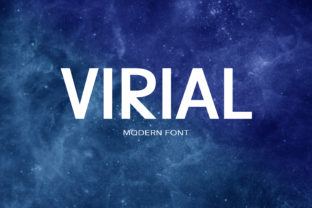
Virial: A Thoughtful Sans Serif for Clarity and Consistency
Virial stands out not by shouting, but by listening—carefully—to the needs of people who design, write, publish, and communicate with intention. It’s a sans serif typeface built on restraint, legibility, and quiet confidence. Unlike many contemporary fonts that chase novelty through exaggerated proportions or stylistic quirks, Virial opts for precision in spacing, neutrality in tone, and reliability across contexts. That makes it especially useful for professionals who need typography to support meaning—not distract from it.
What Makes Virial Distinctive (Without Being Showy)
Virial isn’t experimental, nor is it derivative. Its design reflects a clear understanding of text behavior at multiple sizes and on varied screens. The letterforms balance geometric discipline with subtle humanist warmth: vertical strokes are consistent but not rigid; terminals are cleanly cut, not flared or tapered; counters are open and generous without sacrificing definition. The x-height sits comfortably between modest and assertive—supporting readability in UI labels, body copy, and captions alike.
Its simplicity is intentional, not minimal for minimalism’s sake. There’s no hidden complexity in alternate glyphs or stylistic sets—just one well-tuned weight family (Light, Regular, Medium, SemiBold, Bold) with matching italics. Each weight shares proportional spacing and optical sizing cues, so switching from body text to a callout doesn’t introduce visual dissonance. That consistency matters more than designers often admit—especially when iterating quickly across mockups, documentation, or live sites.
Where Virial Performs Best
In practice, Virial shines where clarity and neutrality are non-negotiable. Consider a SaaS dashboard: interface labels, status messages, and data tables benefit from its even rhythm and unambiguous character shapes. A small business owner building a brand kit finds Virial dependable for everything from invoice headers to social media graphics—no need to juggle multiple fonts to cover different functions. Educators preparing slide decks or handouts appreciate how it remains legible at smaller sizes and under less-than-ideal projection conditions.
It also works well in editorial environments—particularly digital-first publications. Its Regular weight holds up over long paragraphs on screen, while its SemiBold provides clean hierarchy without heaviness. One freelance writer noted using Virial for both email newsletters and printed client reports, citing how its ink traps and stroke contrast translated reliably across PDF exports and retina displays. That cross-medium resilience isn’t guaranteed with every modern sans, and it reduces time spent tweaking fallbacks or adjusting line heights per platform.
Usability and Integration Realities
Viral integrates smoothly into standard web workflows. It’s available via Google Fonts and supports Latin, Greek, and Cyrillic scripts with full diacritic coverage—including extended characters used in Scandinavian, Central European, and Turkish languages. Variable font versions aren’t yet part of the official release, but the discrete weights are well-spaced and interpolation-friendly if you’re building custom axes later.
For developers, loading is straightforward: lightweight file sizes (under 100 KB for the full set), optional subsetting, and native font-display: swap compatibility help avoid invisible text during load. Designers using Figma or Adobe Creative Cloud report accurate rendering across platforms—no unexpected kerning jumps or missing glyphs mid-edit. That predictability lowers friction during collaboration, especially when handing off designs to developers unfamiliar with niche type families.
Audience Fit: Who Gains the Most?
Virial suits professionals who prioritize function over flourish—and who understand that “neutral” doesn’t mean “bland.” Entrepreneurs launching MVP websites often choose Virial because it communicates competence without pretension. Marketers crafting landing pages value how its clean forms guide attention toward content and CTAs rather than competing with them. Bloggers and independent publishers use it to maintain visual continuity across posts, archives, and RSS feeds—where inconsistent typography can erode perceived authority.
It’s also a pragmatic choice for educators building accessible course materials. Its open counters, moderate contrast, and generous letter spacing meet WCAG 2.1 AA recommendations for body text at 16px and above. One university communications team replaced a heavier, more decorative sans with Virial across their intranet—and saw measurable improvements in task completion rates during usability testing, particularly among users with mild visual processing differences.
Limits to Acknowledge
Virial isn’t designed for expressive branding systems that rely on strong personality or typographic storytelling. If your project hinges on conveying playfulness, luxury, or rebellion through type alone, Virial won’t deliver those signals—it’s not meant to. Similarly, while its weights scale well, it lacks ultra-light or black variants, so extreme contrast hierarchies (e.g., delicate captions paired with bold headlines) may require complementary fonts.
Also worth noting: Virial doesn’t include extensive OpenType features like contextual alternates or discretionary ligatures. That’s a deliberate omission—not a gap. For most professional applications (UI, documentation, reports, presentations), those features add little functional value and can complicate implementation. But if your workflow depends heavily on automated glyph substitution for multilingual publishing, you’ll want to verify coverage for your specific language combinations before committing.
Practical Recommendations for Getting Started
Start with the Regular and SemiBold weights. They cover ~90% of typical use cases: body copy, subheads, buttons, and form fields. Use Regular at 16–18px for web body text, with line height around 1.5–1.6. For print, 11–12pt works well with 14–15pt leading. Avoid setting Virial below 14px on screen unless it’s short labels with ample padding—the lowercase ‘a’, ‘e’, and ‘s’ begin to lose distinction at smaller sizes.
Pair it thoughtfully. Virial pairs cleanly with serif companions like IBM Plex Serif, Source Serif Pro, or even traditional options like Charter—the contrast feels purposeful, not arbitrary. For monospace needs (code blocks, terminal snippets), Fira Code or JetBrains Mono complement Virial’s proportions without clashing in tone.
Test early and often—not just on your primary device, but on older tablets, lower-resolution laptops, and mobile browsers with default zoom settings. Virial’s strength lies in its adaptability, but only if you validate that behavior in real conditions. One small business owner discovered that while Virial looked crisp on her MacBook, its Light weight rendered slightly thin on Windows Chrome until she adjusted font smoothing settings—a reminder that “clean” doesn’t always mean “plug-and-play” across all environments.
Virial earns its place not through flash, but through fidelity—to language, to context, and to the people using it to share ideas. It’s the kind of typeface that fades into the background just enough to let content breathe, yet remains unmistakably itself when examined closely. For anyone balancing aesthetics with accountability—whether drafting a pitch deck, designing a nonprofit’s annual report, or refining a developer documentation site—Virial offers a grounded, capable, and quietly intelligent foundation.