Fress: A Modern Sans Serif Designed for Clarity and Character
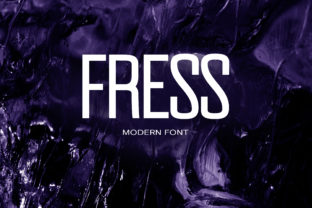
Fress is a contemporary sans serif typeface built with intention—not just aesthetics, but function, rhythm, and quiet confidence. It avoids the extremes of geometric rigidity and humanist softness, landing instead in a refined middle ground where open apertures, balanced proportions, and subtle stroke modulation support both screen legibility and print presence. Unlike many modern sans serifs that prioritize neutrality above all, Fress carries a gentle personality: its lowercase a and g feature distinctive single-story forms, its terminals are cleanly cut but not blunt, and its x-height sits comfortably high without crowding ascenders or descenders.
What Sets Fress Apart From Other Contemporary Sans Serifs
Many designers reach for widely available sans serifs—Helvetica, Inter, Roboto, or newer system fonts like SF Pro or Segoe UI—because they’re familiar, well-tested, and often free. Fress doesn’t compete on ubiquity. Instead, it offers something harder to quantify but increasingly valuable: intentional differentiation within a crowded category. Where Helvetica leans into structural austerity and Inter optimizes for interface density, Fress balances visual warmth with typographic precision. Its letterforms breathe more freely than condensed alternatives, yet remain tighter and more cohesive than looser humanist options like Lato or Open Sans.
This balance shows up in practical ways. For example, at 16px on a standard laptop display, Fress maintains readability without requiring extra line height or letter spacing adjustments—unlike some ultra-thin or tightly spaced sans serifs that blur or fatigue the eye over longer text blocks. In headings, its slightly increased stroke contrast (subtle but present) adds weight and hierarchy without resorting to bold-only emphasis. That makes it effective across contexts—from editorial layouts to product dashboards—without needing heavy stylistic overrides.
Fitting Into Real-World Design Workflows
Fress works best when clarity and tone matter equally. Consider a brand refresh for a mid-sized design studio: their current site uses a generic system font, and while it’s functional, it doesn’t reflect their craft-focused approach. Switching to Fress—used consistently for body copy, captions, and subheadings—introduces quiet distinction. It signals attention to detail without shouting; it feels considered, not trendy. Similarly, in a long-form digital publication, Fress supports sustained reading better than overly geometric fonts that can feel cold or monotonous over paragraphs.
It’s also well-suited for responsive environments. The family includes six weights (Thin through Black), each with matching italics, and extensive language support—including Latin, Greek, Cyrillic, and basic Vietnamese characters. That means it scales reliably from mobile captions (Light or Regular) to desktop hero text (Bold or Black), and handles multilingual content without fallback surprises. Unlike variable fonts that require careful axis tuning, Fress delivers consistent behavior across browsers and platforms without configuration overhead.
Tradeoffs to Acknowledge Before Choosing
No typeface excels in every scenario—and Fress is no exception. Its strengths lie in medium-to-long text and clean, contemporary interfaces. It’s less ideal for situations demanding extreme economy of space (e.g., dense data tables or tight mobile navigation bars), where narrower, more compressed sans serifs may perform better. Likewise, Fress isn’t designed for expressive branding applications that rely on dramatic contrast—think luxury fashion campaigns or experimental art direction—where custom-drawn or highly stylized typefaces would carry more conceptual weight.
Another consideration is licensing and delivery. Fress is not open source or bundled with operating systems. It requires a commercial license, and while the pricing model is straightforward (one-time purchase per project or perpetual use), it does introduce an upfront cost that may not align with leaner workflows or early-stage startups evaluating dozens of tools. Compare that to Inter or Roboto—freely available, instantly embeddable, and supported by default in most CMS and design tools. If speed-to-deployment and zero licensing friction are top priorities, those alternatives hold clear practical advantages.
When Fress Is Likely the Right Choice
- You need typographic consistency across print and digital outputs—Fress renders predictably in PDFs, web CSS, and native apps, reducing QA time spent fixing rendering quirks.
- Your audience engages with extended text, such as newsletters, documentation, or blog posts—and you want readability without sacrificing visual identity.
- You’re building a brand voice that values clarity, calm confidence, and craftsmanship—not minimalism for its own sake, but restraint with purpose.
- You prefer a curated, finite set of weights and styles over variable font complexity, and want full control over how each weight behaves in your layout system.
When Another Option May Serve Better
- You’re prototyping rapidly and need instant, no-setup typography—system fonts or Google Fonts like Inter or Manrope offer faster iteration without licensing steps.
- Your design system already relies heavily on a variable font—and you benefit from continuous weight/width/italic interpolation for dynamic scaling or animation.
- You require extensive OpenType features—such as contextual alternates, stylistic sets, or advanced numeral variants—that go beyond Fress’s focused feature set (which prioritizes language coverage and baseline stability over decorative flourishes).
- You’re designing for low-bandwidth or legacy environments—where font loading performance is critical, and self-hosted WOFF2 files add latency that system fonts avoid entirely.
Practical Comparison: How Fress Performs Alongside Common Alternatives
Let’s look at three common evaluation points—legibility, versatility, and implementation effort—across Fress and two frequently considered options:
- Inter: Excellent screen legibility and developer-friendly, especially in UI contexts. However, its high x-height and tight spacing can feel cramped in longer paragraphs or print. Fress offers more generous spacing out of the box and slightly softer rhythm—making it easier to sustain attention across pages.
- Helvetica Now: A refined update to a classic, with improved spacing and optical sizing. It remains highly neutral—ideal for corporate environments where universality is key. Fress, by contrast, introduces just enough character to signal intentionality without compromising professionalism.
- Manrope: A friendly, rounded sans with strong accessibility credentials. Its rounded terminals soften tone effectively—but may feel too casual for technical or formal contexts where Fress’s cleaner geometry reads as more authoritative.
The difference isn’t about “better” or “worse.” It’s about alignment. If your goal is seamless integration into an existing stack, Inter or Manrope may reduce friction. If your goal is to quietly elevate tone while maintaining rigor, Fress offers a distinct, dependable path.
Making the Decision Without Overcomplicating It
Choosing a typeface isn’t about finding the “best” one—it’s about identifying the one that supports your goals without drawing undue attention to itself. Fress succeeds when it disappears into the experience just enough to feel inevitable, yet remains memorable in retrospect. It’s not flashy, nor is it invisible. It occupies a thoughtful middle space—one that rewards close reading and long-term use.
Before committing, test Fress in your actual environment: set real body copy at your typical sizes, check contrast ratios against your background colors, preview it alongside your primary imagery, and ask whether it feels like a natural extension of your voice—not a stylistic imposition. Try pairing it with a simple serif (like Adobe Garamond or PT Serif) for headings if you want added texture without competing energy.
And remember: typography is iterative. You don’t need to get it perfect on the first pass. What matters is choosing a foundation that grows with your work—not one that limits it. Fress provides that kind of grounded flexibility: restrained enough to trust, distinctive enough to matter.