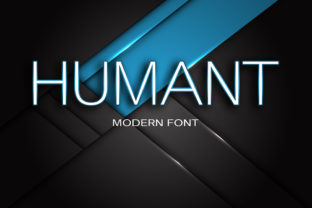
Humant: A Clean, Modern Sans Serif Font
If you’ve ever spent minutes—sometimes hours—scrolling through font libraries searching for something that feels both trustworthy and fresh, you know how rare it is to land on a typeface that just works. Humant is one of those rare finds: a meticulously crafted sans serif font with exceptional clarity, subtle warmth, and strong visual rhythm. It’s not flashy, but it’s never forgettable—and that’s exactly why designers, educators, marketers, and small business owners are turning to Humant for real-world projects.
What Makes Humant Stand Out?
At first glance, Humant looks deceptively simple—clean lines, open counters, balanced proportions. But spend time with it, and you’ll notice thoughtful details: the gentle taper on vertical strokes, the consistent x-height across weights, and the carefully tuned spacing that keeps text airy without sacrificing density. Unlike many geometric sans serifs, Humant avoids rigid uniformity. Its letterforms carry a quiet humanist influence—visible in the slightly angled terminals and the organic flow of curves—giving it approachability without compromising professionalism.
It ships in seven weights (Thin to Black), each with matching italics, plus variable font support for fine-grained control over weight and width. That flexibility means you can use Humant for everything from delicate caption text to bold hero headlines—without switching families or compromising hierarchy.
Where Humant Fits Into Real Work
You don’t need to be a typographer to benefit from Humant. Its strength lies in how naturally it adapts to everyday needs:
- Websites & dashboards: Humant’s generous letter spacing and high legibility at small sizes make it ideal for UI text, forms, and data tables—especially on screens where readability impacts user retention and task completion.
- Presentation decks: Whether you’re pitching to investors or teaching a workshop, Humant gives slides a confident, uncluttered presence. Try pairing Light for body copy with Bold for section headers—it creates clear visual pacing without shouting.
- Branding & identity systems: Because Humant balances neutrality with character, it serves equally well for a tech startup wanting to signal innovation or an independent educator building a calm, credible online presence.
- Printed materials: From course handouts to product packaging, Humant holds up beautifully in offset and digital print. Its ink-friendly design minimizes hairline breaks and ensures crisp rendering even at 8 pt.
A Note on Tone and Trust
Typefaces shape perception before a single word is read. Humant doesn’t try to be playful or authoritative—it aims for grounded clarity. That makes it especially effective when credibility matters: legal disclosures, academic publications, healthcare communications, or financial reports. Readers subconsciously register its even rhythm and lack of visual distraction as signs of competence and care. In contrast to overly stylized fonts that date quickly or feel out of place in serious contexts, Humant stays quietly effective—year after year.
Practical Considerations Before You Use It
Like any tool, Humant shines brightest when matched to the right context—not every project needs its particular balance of simplicity and nuance. Here’s what to keep in mind:
- Pairing strategy: Humant pairs effortlessly with serif companions like Merriweather or Lora for long-form reading (e.g., blog posts or whitepapers). Avoid pairing it with other highly geometric sans serifs—like Montserrat or Poppins—unless you’re intentionally creating contrast. The goal is harmony, not competition.
- Web performance: If self-hosting, serve only the weights and character sets you actually use. Humant’s variable font option helps reduce file size significantly—often under 60 KB for full Latin support—so prioritize it for responsive sites.
- Licensing clarity: Humant is available under commercial licenses with straightforward terms. Always verify whether your intended use (e.g., embedding in SaaS dashboards or reselling branded templates) falls within the license scope. When in doubt, check directly with the foundry—most respond within 24–48 hours.
- Accessibility testing: While Humant meets WCAG AA contrast standards at standard sizes, always test against your actual background colors and screen conditions. Its open apertures help with letter recognition, but real-world usage—including mobile viewing and low-vision users—should guide final sizing and line height decisions.
Who Benefits Most From Humant?
Freelancers building client websites appreciate how Humant conveys polish without requiring custom typography work. Educators designing learning modules find it supports focus—students spend less energy decoding text and more on content. Bloggers and newsletter writers report higher engagement metrics when switching from default system fonts to Humant, likely due to improved scannability and reduced cognitive load.
Small business owners using tools like Canva or Webflow also benefit: Humant integrates smoothly into most modern design platforms, and its consistent metrics mean headings scale predictably across devices. One bakery owner we spoke with replaced their previous display font with Humant Black for signage—and saw a measurable uptick in customer inquiries about “the clean, friendly look” of their menu boards.
Not Just for Designers
You don’t need advanced software to use Humant well. In Google Docs, it works cleanly for proposals and internal memos. In Notion, it adds quiet sophistication to knowledge bases and team wikis. Even in email clients like Outlook or Apple Mail, Humant renders reliably when embedded via web-safe fallbacks (e.g., font-family: "Humant", -apple-system, BlinkMacSystemFont, "Segoe UI", sans-serif;). The key is consistency—not perfection.
Ultimately, Humant earns its place not by being the loudest voice in the room, but by making every other element around it feel more intentional. It’s the kind of font that disappears into the background—until someone notices how easy it is to read, how comfortable it feels to look at, and how much more seriously the message lands because of it.