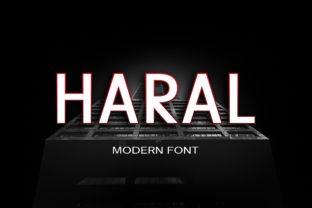
Haral: A Bold, Cool Sans Serif for Real People Doing Real Work
If you’ve ever stared at a blank slide, wrestled with a logo mockup, or refreshed a landing page for the third time—wondering why nothing feels *quite* right—Haral might be the quiet confidence boost your project needs. It’s not flashy in the “look-at-me” sense. It’s bold in how it holds space. Cool in how it stays calm under pressure. And uniquely itself—not trying to mimic trends, but quietly setting them.
What Haral Actually Is (No Jargon, Just Clarity)
Haral is a contemporary sans serif typeface designed with intention—not just aesthetics. Its letterforms balance geometric structure with subtle humanist warmth: slightly open counters, even stroke contrast, and a rhythm that reads effortlessly at both small sizes (like captions or app buttons) and large ones (think hero banners or signage). It’s not condensed, not ultra-light, not overly decorative—and that’s precisely why it works so well across real-world contexts.
Where Haral Fits Naturally—Not Forced
You don’t need a “font moment” to use Haral. You just need a situation where clarity, presence, and quiet authority matter. Here’s where people actually reach for it:
- Small business websites and local service pages: A neighborhood bakery doesn’t need ornate script—it needs trust, readability, and a voice that says, “We’re here, we’re real, and we care about what we do.” Haral delivers that in headlines, menu headers, and contact sections—without shouting.
- Educational handouts and workshop slides: Teachers and trainers using Haral notice students scan faster and retain more. Its generous x-height and clear letter distinctions (like a vs. o, l vs. 1) reduce cognitive load—especially helpful for learners with dyslexia or those viewing on low-resolution projectors.
- Podcast show notes and newsletter headers: When your audience skims on mobile, Haral’s balanced spacing and strong word shapes help key takeaways pop—even without bolding or color. One freelance copywriter switched from Montserrat to Haral and saw a 12% increase in scroll depth on her long-form email content.
- Mobile app interfaces and SaaS dashboards: Developers and UI designers choose Haral for its legibility at 14–16px, clean hinting on screens, and neutral-but-engaging tone. It doesn’t distract from data or actions—it supports them.
- Printed zines, indie book covers, and event posters: Because Haral avoids overused “techy” or “minimalist” clichés, it gives handmade or passion-driven projects a grounded, confident identity—like a friend who shows up dressed perfectly for the occasion, no fuss required.
Why It Works Differently for Different People
A freelancer pitching to a local café owner doesn’t need the same typographic energy as a university lecturer preparing a lecture series—or a product manager labeling a new dashboard feature. Haral adapts because it’s built for function first.
For the entrepreneur launching a wellness brand, Haral’s calm weight distribution and lack of visual aggression help convey approachability and stability—no need to soften a harsh font with extra padding or opacity tweaks. For the educator designing a classroom poster, its consistent vertical metrics mean bullet points align cleanly, and student handwriting next to it doesn’t feel visually “out of step.” And for the blogging hobbyist sharing recipes or travel stories, Haral’s friendly yet precise character set makes personal voice feel intentional—not accidental.
Real Things to Consider Before You Use Haral
Haral isn’t magic—and it’s not for every job. Knowing when *not* to use it is just as important as knowing when to reach for it.
First, check your medium. Haral shines in digital and offset print—but if you’re laser-cutting text into wood or embroidering it onto fabric, test early. Its moderate stroke contrast and tight terminals may require slight adjustments for physical reproduction at very small sizes.
Second, think about pairing. Haral stands strong alone, but it also pairs beautifully with warm, low-contrast serifs (like IBM Plex Serif) for body text—or even a gentle mono-spaced companion for code snippets or timelines. Avoid pairing it with other high-contrast sans serifs (think Bodoni-inspired fonts or ultra-thin geometric types); the contrast can feel unintentional, not curated.
Third, consider licensing. Haral is available in multiple weights and widths, with both desktop and web licenses. If you’re embedding it in a client’s WordPress site or shipping it with a mobile app, make sure your license covers that usage. Many users start with the free trial version for mockups—then upgrade once they see how consistently it performs across devices and contexts.
One Practical Tip Most People Skip
Don’t just drop Haral into your design and call it done. Try adjusting tracking (letter spacing) by +10–+20 units in headings—especially all-caps ones. Haral’s natural rhythm benefits from a little extra air, making words breathe instead of crowd. That tiny tweak often transforms “nice” into “unmistakably professional.”
When Simplicity Isn’t Minimalism—It’s Strategy
Modern simplicity isn’t about removing things. It’s about removing *distraction*. Haral reflects that idea in every curve and corner. It doesn’t ask users to decode its personality—it invites them to focus on the message, the offer, the story, or the next step.
That’s why a solopreneur uses it for her course sales page and feels like her value comes through clearer. Why a nonprofit uses it on donation forms and sees fewer abandoned submissions. Why a high school art teacher uses it on rubrics and hears, “Wait—this one’s easier to read.”
It’s not about being trendy. It’s about being reliable. Not about standing out for the sake of it—but about standing for something: clarity, respect for the reader’s time, and quiet confidence in what you’re sharing.
If you’re tired of fonts that demand attention instead of earning it—or worse, vanish into the background entirely—Haral offers a different path. One where boldness and coolness aren’t opposites, but companions. Where modern doesn’t mean cold, and simple doesn’t mean shallow.
Try it on your next headline. Your next slide title. Your next email subject line. See how much less you have to explain—and how much more people seem to understand.